
What Is the Universal Commerce Protocol (UCP)?
UCP is the open protocol that lets an AI agent discover your products, build a cart and complete a checkout without a human touching your site. Here is what the capability document on your own domain contains, how a single handshake actually runs, and the two fields merchants should be checking today.
Definition
The Universal Commerce Protocol (UCP) is an open protocol for agent-driven commerce. It standardises how an AI agent discovers a merchant, retrieves products, builds a cart, prepares a checkout, applies discounts, selects fulfilment and queries orders. The specification lives at ucp.dev. It was led by Google and developed with retailers including Shopify, and it is designed to sit alongside Google's agent payment and agent-to-agent protocols.
For a merchant, the useful mental model is simpler: UCP is a machine-readable version of your store. Where a human reads a product page, an agent reads a JSON object. Where a human clicks Add to cart, an agent calls a tool. Everything that is not in the protocol response effectively does not exist on that path.
On Shopify, protocol support is handled by the platform. Eligible stores publish a discovery document at /.well-known/ucp and serve tools from /api/ucp/mcp. Shopify's own engineering write-up is at shopify.engineering/ucp, and the full developer documentation for the agent journey is at shopify.dev/docs/agents.
Open your own capability document first
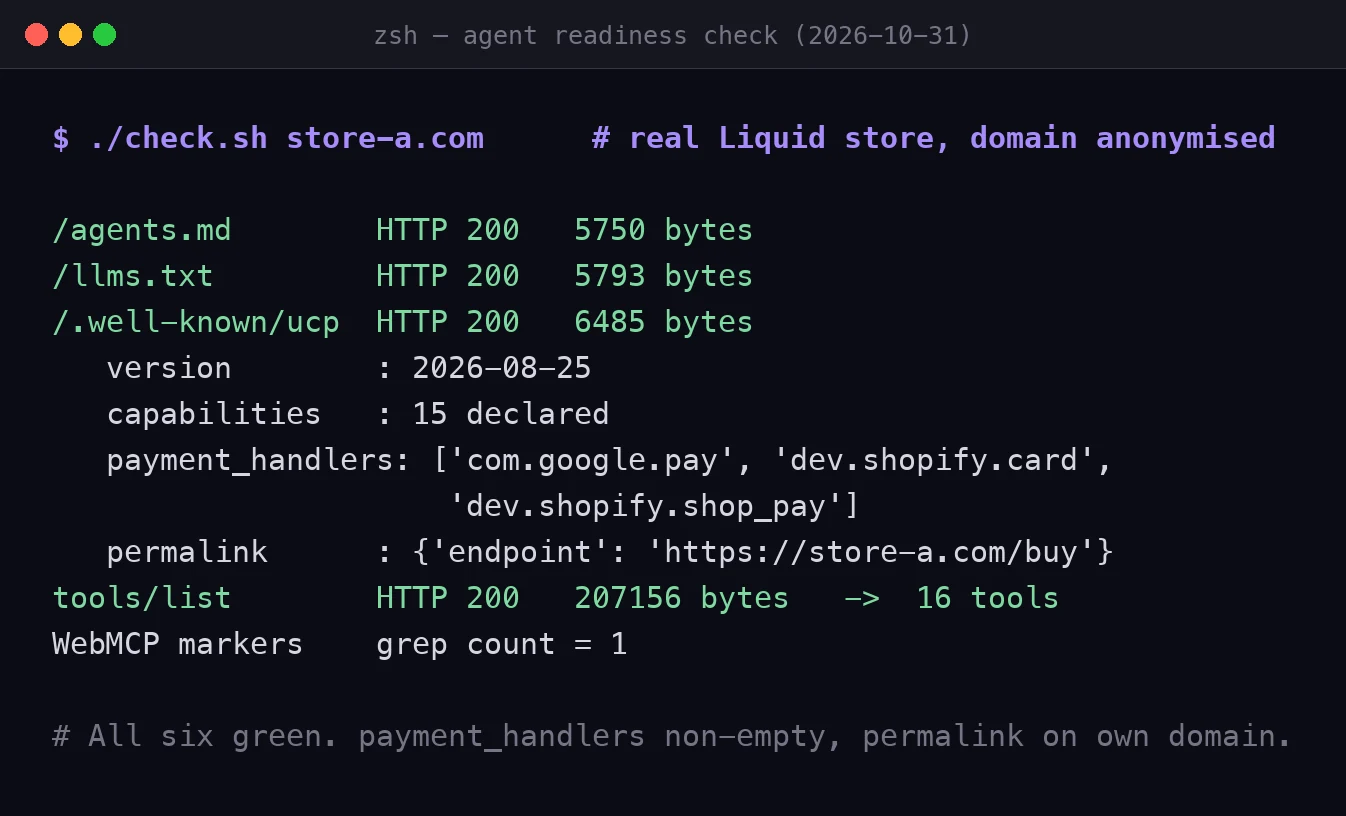
Before reading any more theory, open https://yourdomain.com/.well-known/ucp in a browser. It is a public endpoint — no key, no login. It answers four questions: which protocol version your store negotiated, where the MCP service endpoints are, which capabilities are declared, and which payment handlers are supported.
The capability list is the part worth reading closely, because it describes what an agent is permitted to do with you: catalogue search and lookup, cart, checkout, fulfilment, discount, buyer consent, order lookup, permalinks, Shop account linking, and — for brands with physical stores — location search. There is also a Shopify-specific catalogue extension beyond the standard set.
The two fields most merchants are not checking
We pulled this document from eight live Shopify storefronts on 2026-10-31. Two fields are worth your attention, for different reasons.
The first is payment_handlers. All eight stores declared a non-empty set, typically Google Pay alongside Shopify's own card and Shop Pay handlers — so in this sample it passed every time. We still list it because it is the field nobody looks at and the one whose failure is completely invisible: an empty object means there is no usable payment rail for that store inside an agent checkout path, no matter how good the catalogue looks. Check it; expect it to pass.
The second is where the permalink capability points — and this one did fail. Six of the eight resolved to the brand's own domain. Two pointed somewhere else: one at a myshopify domain, one at a separate shop subdomain. A third resolved to a regional checkout subdomain, which is a deliberate configuration rather than a fault. When that endpoint leaves your apex, the agent's direct-to-checkout link leaves your brand at the highest-intent moment in the journey, with everything that implies for trust, analytics and brand consistency.
How one handshake actually runs
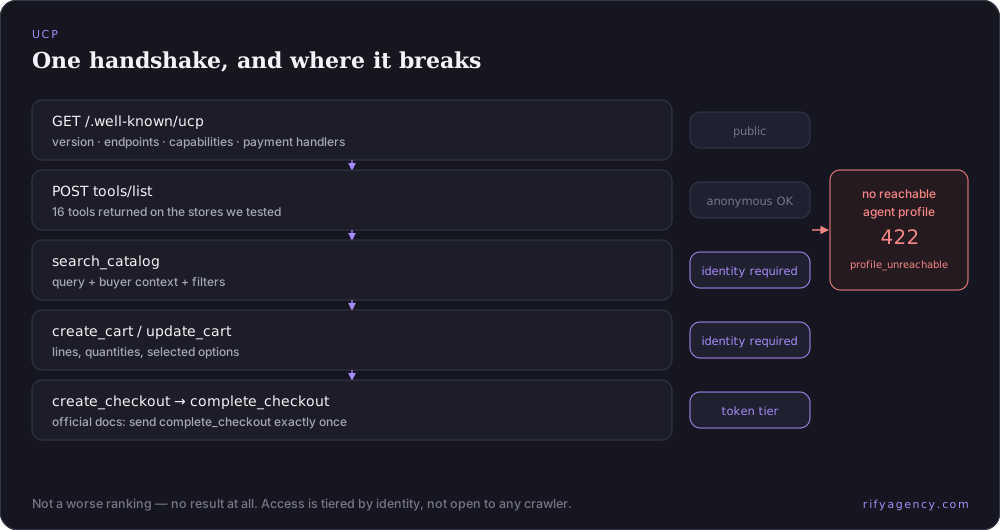
- The agent fetches /.well-known/ucp to learn your version, endpoints and capabilities.
- It connects to the MCP endpoint and calls tools/list to retrieve the available tools and their schemas. In our testing this listing was callable anonymously and returned roughly fifteen tools across catalogue, location, cart, checkout and order groups.
- It calls catalogue search with a query, a buyer context (country, currency) and filters. This is where identity matters: using an unreachable agent profile URL, the search call failed outright with a profile-unreachable error rather than returning a worse ranking.
- It builds a cart, then creates and updates a checkout, resolving fulfilment options and discounts.
- It completes the checkout — which the documentation treats as a call you make once — or, where eligibility is missing, degrades to an escalation plus a hand-off link.
Identity replaced anonymity
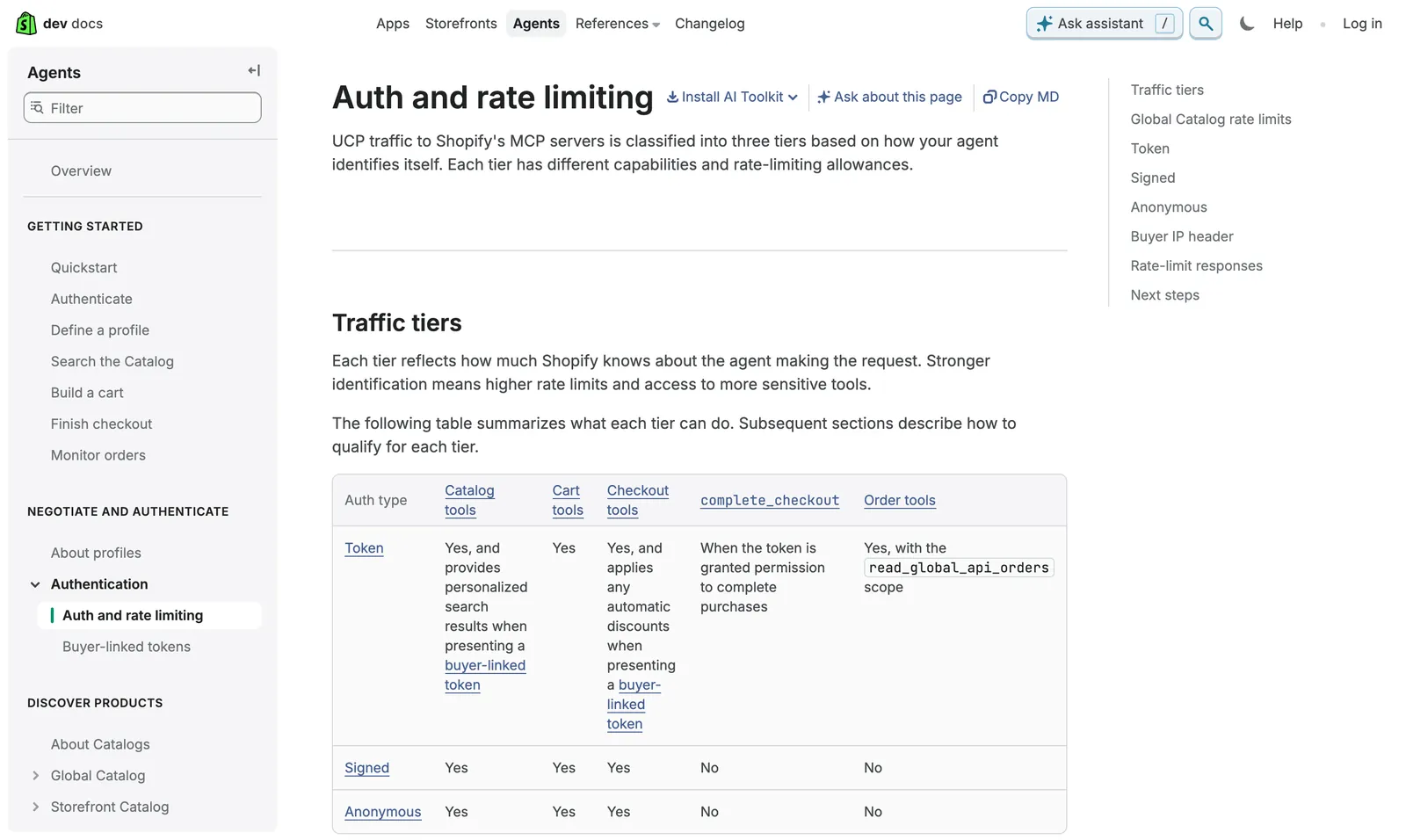
The change that surprises most SEO teams is that access is now tiered by identity, not open to anyone with a user agent string. Shopify documents trust tiers and rate limiting at shopify.dev/docs/agents/profiles/auth-and-rate-limiting: token-bearing, signed and anonymous requesters get different capability sets and different limits, and the highest-value actions sit behind the strictest tier.
Two consequences follow. Tooling that monitors AI visibility by crawling will increasingly be blocked, because the protocol expects a signed, publicly resolvable agent identity rather than a scraper. And AI visibility stops being purely a content problem: however good your product data is, a requester without sufficient trust simply cannot call some tools.
What UCP changes about your job
- Your product data becomes an API response. Write descriptions that survive extraction, not just persuasion.
- Eligibility becomes a gate. Policies, terms acceptance, images, non-zero prices and channel publication are pass/fail prerequisites, not best practice.
- Checkout configuration becomes a growth lever. Native checkout eligibility and a non-empty payment handler decide whether an agent can close in-conversation.
- Protocol health becomes a monitoring item. Capability lists and versions drift; a quarterly screenshot is not monitoring.
- Attribution has to move server-side, because a purchase completed in a conversation never loads your thank-you page.
Getting a read on your own store
None of the checks above require access to your admin — the discovery document and the tool listing are public. If you would rather have someone run them properly, interpret them against the two catalogues, and turn the output into a prioritised remediation list, that is precisely what our Agentic Commerce and AI Visibility (GEO/AEO) services do.
Send us the domain and we will come back with what agents can currently see, what they cannot call, and the shortest path to closing the gap.
常見問題
Is UCP the same thing as MCP?
No. MCP (Model Context Protocol) is the general mechanism by which a model calls external tools. UCP is a commerce-specific protocol that defines which tools exist, what they accept and what they return — and it uses MCP as one of its transports.
Do I have to implement UCP myself on Shopify?
Generally no. Protocol support is provided by the platform for eligible stores. Your responsibilities are eligibility, data quality, checkout configuration and verifying the endpoints are actually live on your own domain — which is where headless storefronts most often fall down.
Can I see what an AI agent sees about my store?
Partly, and without credentials. The discovery document at /.well-known/ucp and the tool listing on your MCP endpoint are publicly readable. Actually executing a catalogue search requires a publicly reachable agent identity profile, which is why casual scraping of that step fails.
What happens if I do nothing?
Your store keeps working for human buyers. On the agent path you are likely to be retrievable but weaker: missing filterable attributes, no published policy facts, and possibly no in-conversation checkout — which in practice means agents hand buyers off to competitors who can close.
延伸閱讀
 Shopify Editions Fall '26: The Updates That Change Acquisition222 updates, 11 sections, and most coverage focused on the wrong ones. We read Shopify's own structured release data to find where the weight sits — and pulled out the nine updates that change how a brand gets found, chosen and measured.→
 Your Analytics Undercounts Agentic Orders: How to Fix ItWhen a purchase completes inside an AI assistant, your thank-you page is never loaded, so every event bound to it silently stops firing. Revenue is fine. Reporting is not. Here is the system-by-system repair, and why this is the first project rather than the last.→
 Promoted Placement: Paid Rank Inside AI Shopping AnswersShopify's cross-store catalogue now blends paid placements into the ranked organic results an AI agent sees, with a commission attached and mandatory disclosure. This is the moment agentic commerce gets an advertising layer — and the line between paid and organic is blurry by design.→
 Google AI Mode and Gemini Checkout for Shopify BrandsCheckout powered by Shopify now runs inside Google Search AI Mode and the Gemini app. Your orders, customers and fulfilment are unaffected. Your measurement is not. Here is exactly what breaks, how to repair it, and the three cases where opting out is genuinely worth evaluating.→