
Shopify Editions Fall '26: The Updates That Change Acquisition
222 updates, 11 sections, and most coverage focused on the wrong ones. We read Shopify's own structured release data to find where the weight sits — and pulled out the nine updates that change how a brand gets found, chosen and measured.
How we read the release
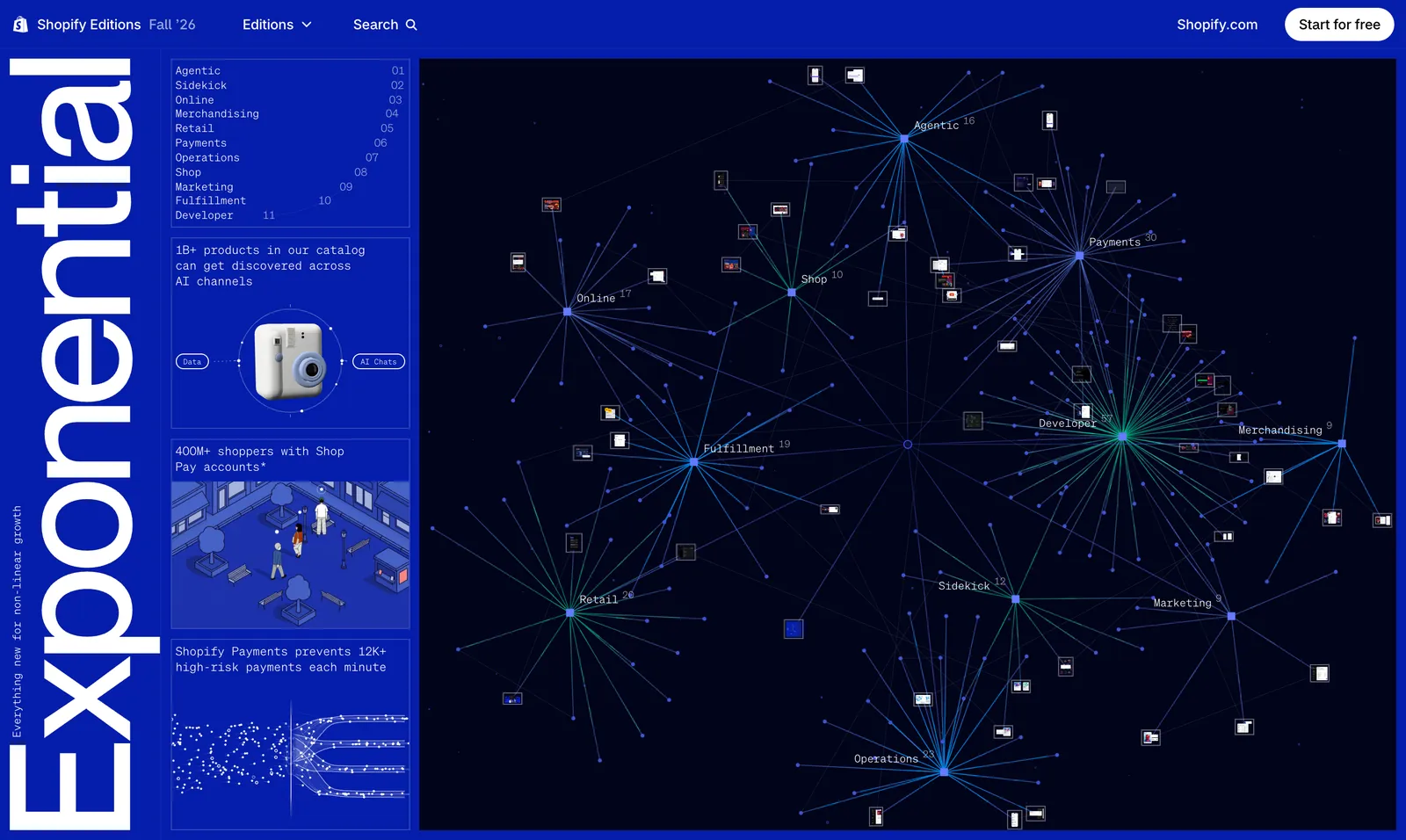
Shopify's Fall '26 Edition was published on 2026-10-28 under the theme Exponential, at www.shopify.com/editions/fall2026. The official page is an interactive star map, which is beautiful and nearly useless for prioritisation — it is easy to walk away remembering only the loudest names.
So rather than reading the page, we read the structured dataset behind it at www.shopify.com/editions/fall2026/graph-data. It returns the full release graph: 11 sections, 222 updates, outcome labels, themes, personas and products, with roughly 1,944 relationship edges — and an official weight from 1 to 5 on every update. That is Shopify's own ranking of its own release, which beats any second-hand summary.
Three readings that reorder your priorities
- Developer holds 57 of 222 updates — 25.7%, nearly double the second-largest section. The primary audience for this release was not merchants clicking buttons; it was systems plugging in. Shopify spent its engineering budget on supply-side plumbing.
- Agentic contains only 16 updates but carries the highest average official weight of any section. Fewest items, heaviest stated importance — the signature of a foundation that other sections stand on.
- Discoverability as an outcome label is attached to roughly 7% of updates, while time-saved and conversion labels dominate. Shopify did not package this as a traffic opportunity. It packaged it as a transaction opportunity.
The nine that change acquisition
- Selling in Google Search including AI Mode, and the Gemini app, with checkout powered by Shopify — a new closing surface, and the single biggest change to how your conversions get counted.
- More accurate session measurement with bot filtering and unified journeys — your denominator changed in the same quarter as your numerator. Draw a version line in your dashboards.
- Business details in AI channels — the reviewed knowledge base that lets you approve the facts shared with agents, including policies and FAQs. The one place your own wording reaches agents.
- Compare-at prices in the catalogue — list price is now a field agents receive, which makes promotional framing legible on the agent path for the first time.
- A delivery and returns trust badge, with the stated effect that products carrying it rank higher — operations buying rank, with no media spend.
- Paid promoted placement in the cross-store catalogue, blended into ranked results with declared commission and mandatory disclosure — the advertising layer of agentic commerce.
- An app for advertising inside chats with sponsored placements and performance tracking — conversational ad buying with Shopify-side reporting.
- The new theme architecture, moving page structure back into Liquid with typed contracts and partial updates — explicitly framed around making a page readable end to end by both humans and AI.
- Hydrogen moving from framework to framework-agnostic library, no longer tied to a single deployment target — headless gets much cheaper to adopt, which also spreads the agent-visibility gaps that come with it.
Two hard deadlines to put in your calendar
These are not optional upgrades, and they are the kind of thing that breaks marketing tooling rather than the storefront itself.
First, storefront script tags: as of 2026-10-01 apps can no longer create or update them, and existing ones are scheduled to stop loading on 2027-03-01. If any of your analytics, personalisation, review or popup tooling still injects via script tag, it has a shutdown date. Audit this now rather than in February 2027.
Second, the 2026-10 API version became the latest stable release and carries multiple breaking changes. If you run custom integrations, that is an engineering ticket with a clock on it.
A note on the official numbers
This release came with a lot of impressive statistics — conversion multiples, win-rate improvements, order-value lifts, speed gains. Those are Shopify's own figures, published without sample sizes, control groups or methodology.
We would treat them as directional rather than as forecastable returns, and we would not put them in a business case without saying where they came from. That is not scepticism about the platform; it is the same standard we would apply to our own numbers.
What to do with this in the next 30 days
- Check and record your agentic channel switch state in the admin, with a date. Do not assume.
- Run the public agent-readiness checks on your production domain — endpoints, capability list, payment handlers, permalink destination, browser-side tool registration.
- Audit every marketing tool that injects via script tag and get replacement dates from each vendor.
- Draw the measurement version line in your dashboards and plan the server-side conversion migration.
- Start your knowledge base: publish returns, shipping, warranty and contact facts as self-contained statements with numbers.
- Pick ten category terms and record what assistants currently say about your brand, so you have a baseline before you change anything.
If you want a second pair of eyes
We work on exactly this intersection: Shopify engineering, technical SEO, and the AI search and agentic commerce layer on top. For most brands the right next step is small — a read on your production domain and your current AI visibility, so the roadmap argument is about facts rather than opinions.
If your team is deciding what to prioritise this quarter, or if you have GEO, AEO or AI search acquisition on the plan and want to pressure-test the approach, send us your domain and category and we will come back with what we can verify from outside.
常見問題
Where can I read the release myself?
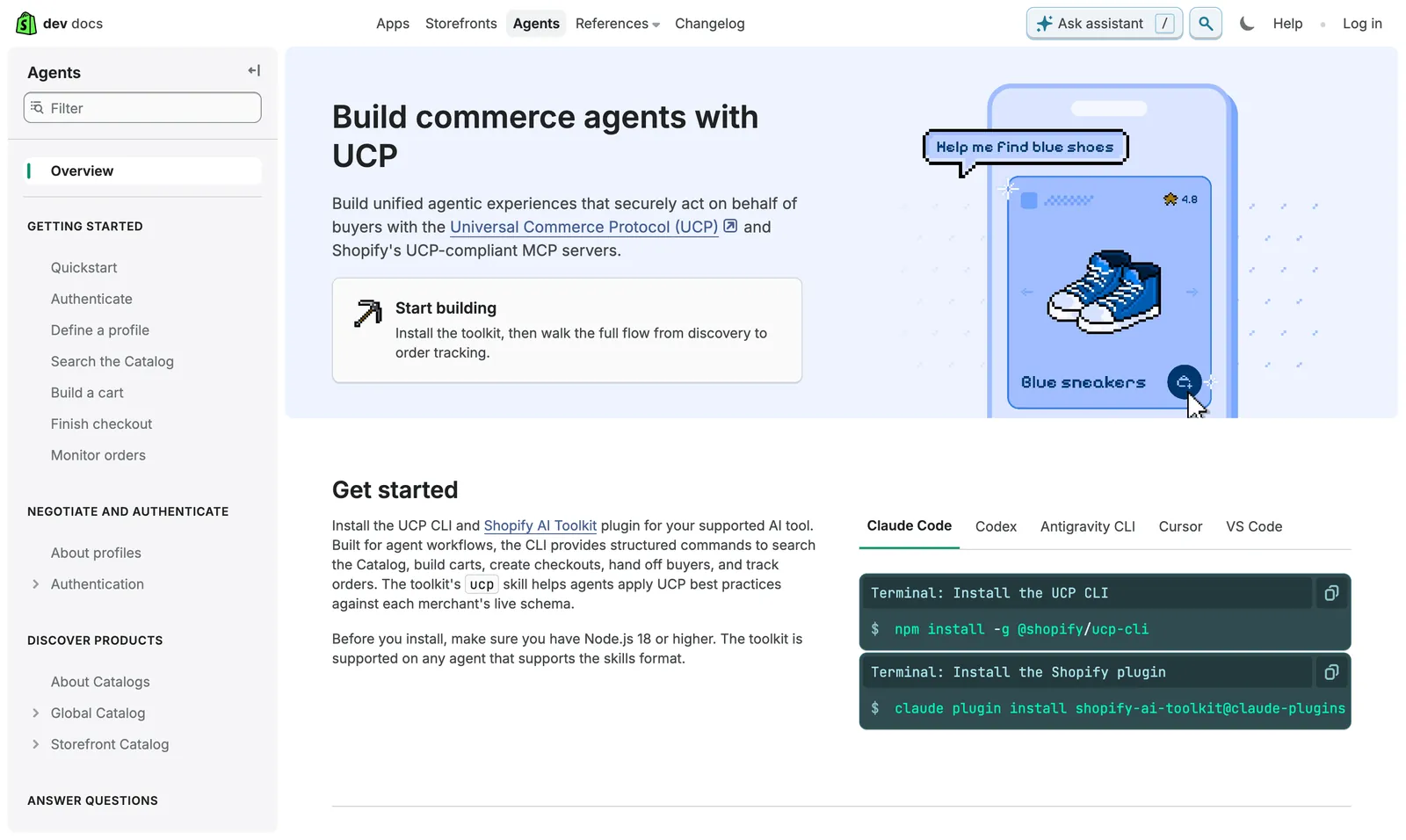
The official page is www.shopify.com/editions/fall2026, and the structured dataset behind it is at www.shopify.com/editions/fall2026/graph-data. The developer documentation for the agent journey is at shopify.dev/docs/agents.
Which single update should a marketing lead care about most?
Checkout running inside Google Search AI Mode and the Gemini app — not because of incremental revenue, but because it changes how your conversions get counted. Measurement breaks before growth appears.
Is any of this urgent if we are a small brand?
Two things are: auditing script-tag-based marketing tooling before the shutdown date, and running the free agent-readiness checks on your domain. Both are cheap, and both have failure modes that are invisible until something stops working.
Do we need to act on the theme architecture and Hydrogen changes now?
Only if a replatform or migration is already on your roadmap — in which case they change the calculus meaningfully, and you should add the agent-visibility checks to your acceptance criteria before you start.
延伸閱讀
 Shopify GEO Strategy After Fall '26: Ranking to Being CalledEcommerce visibility now has three levels, not two: being indexed, being cited, and being callable. They stack rather than replace each other, their failure modes are completely different, and only one of them is a switch. Here is how to structure a GEO programme for a Shopify brand accordingly.→
 Your Analytics Undercounts Agentic Orders: How to Fix ItWhen a purchase completes inside an AI assistant, your thank-you page is never loaded, so every event bound to it silently stops firing. Revenue is fine. Reporting is not. Here is the system-by-system repair, and why this is the first project rather than the last.→
 Promoted Placement: Paid Rank Inside AI Shopping AnswersShopify's cross-store catalogue now blends paid placements into the ranked organic results an AI agent sees, with a commission attached and mandatory disclosure. This is the moment agentic commerce gets an advertising layer — and the line between paid and organic is blurry by design.→
 Google AI Mode and Gemini Checkout for Shopify BrandsCheckout powered by Shopify now runs inside Google Search AI Mode and the Gemini app. Your orders, customers and fulfilment are unaffected. Your measurement is not. Here is exactly what breaks, how to repair it, and the three cases where opting out is genuinely worth evaluating.→