
Your Analytics Undercounts Agentic Orders: How to Fix It
When a purchase completes inside an AI assistant, your thank-you page is never loaded, so every event bound to it silently stops firing. Revenue is fine. Reporting is not. Here is the system-by-system repair, and why this is the first project rather than the last.
Answer first
Agentic orders land in your Shopify admin as normal orders with customer data. Nothing about revenue, fulfilment, support or refunds changes. What breaks is every measurement system that depends on a browser loading your order confirmation page — because on this path, no browser ever does.
The fix is to make order data, not page views, the event source: server-side purchase reporting, conversions APIs, enhanced or server-side ad conversion upload, order-webhook backfill for attribution tools, and audience rebuilds from order records. None of this is novel engineering. It is just work that most ecommerce stacks deferred because the page-based version kept working.
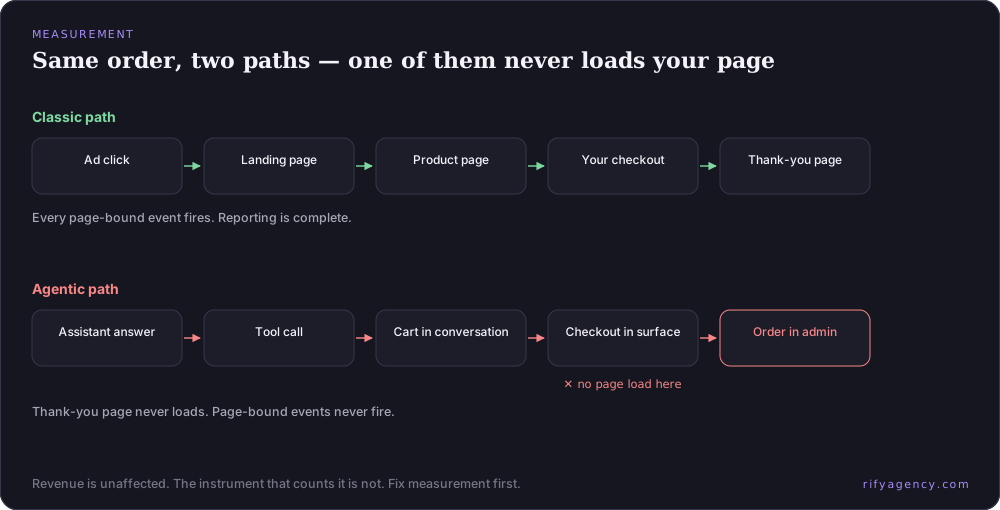
What exactly stops firing
- Page-based analytics purchase and transaction events, and everything derived from them — conversion rate, revenue by channel, funnel completion.
- Advertising pixels placed on the order confirmation page, and therefore the conversion signal your ad platforms optimise against.
- Tag-based ad conversion tracking, which means bidding algorithms stop seeing part of their own results.
- Customer-match and retargeting audiences built from storefront pixel activity — these buyers are simply absent.
- Multi-touch attribution platforms, which develop a gap they cannot distinguish from a genuine decline.
- Any post-purchase on-page experience: upsell widgets, survey prompts, referral capture, review-request triggers bound to the confirmation page.
The second change that makes diagnosis harder
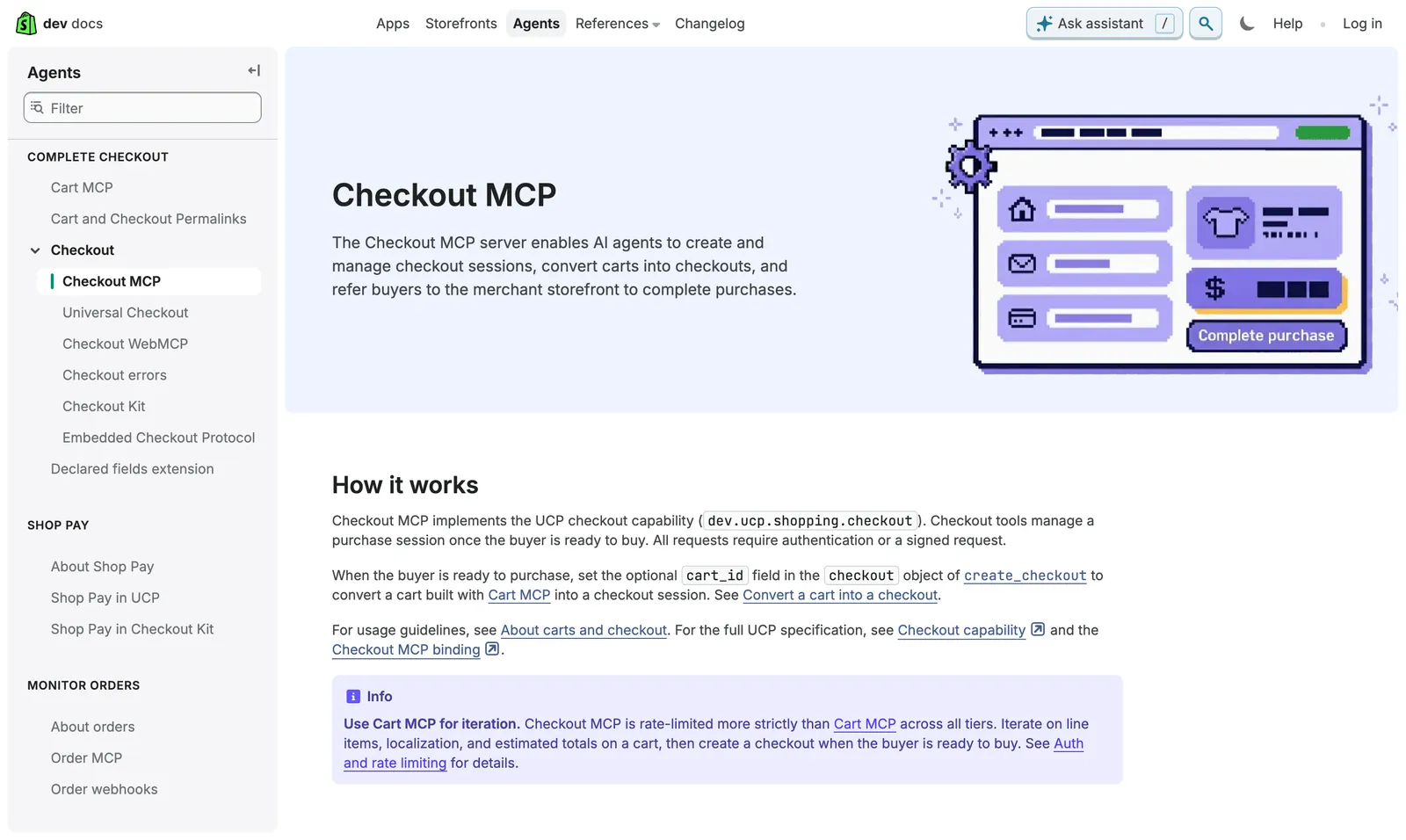
In the same release, Shopify also revised session measurement — bot filtering and unified user journeys, aimed at making sessions reflect human visitors more accurately.
So in a single quarter your denominator changed and your numerator changed, in opposite directions and for unrelated reasons. A conversion-rate comparison across that boundary is not a slightly noisy number; it is a number with no defined meaning. We have seen teams spend weeks hunting for a conversion regression that was entirely a measurement artefact.
The discipline is simple and non-negotiable: draw an explicit version line in your dashboards at the date these changes landed, annotate it, and rebuild your baseline after it. Refuse comparisons across the line.
The repair, in priority order
- Make Shopify order data the source of truth for revenue and order count on this channel. Do this first — it recovers the number leadership actually asks about.
- Move your single most important conversion event to a server-side pipeline reading from orders rather than page loads.
- Switch advertising pixels to a server-side conversions API with the order as the event source, so bidding gets its signal back.
- Switch ad platform conversion tags to enhanced conversions or server-side upload.
- Backfill multi-touch attribution tools from order webhooks, and document that channel granularity is coarser on this path rather than pretending it is not.
- Rebuild customer-match and retargeting audiences from order records.
- Relocate post-purchase experiences that assumed a confirmation page — move review requests and referral capture into email or order-status flows.
- Add the version line and a written measurement note to your reporting so the next analyst does not rediscover this from scratch.
How to report the channel honestly
Once orders are the source of truth, you can report this channel properly, but you should be explicit about what you can and cannot say. You can state order count, revenue, average order value, product mix and new-versus-returning status for agentic orders. You cannot reconstruct the pre-purchase journey with the same granularity, because large parts of it happened in a surface you have no visibility into.
That is a real limitation and it is better stated than papered over. A dashboard that silently blends a channel with no upper-funnel visibility into channel-level attribution models produces confident numbers that are wrong — which is worse than a labelled gap.
Why this is the first project, not the last
Attribution breaks before you see any incremental revenue from the channel. That ordering is the whole problem: by the time anyone asks whether AI channels are working, the instrument that would answer the question has already been quietly degraded.
So the sequence we recommend is unglamorous. Fix measurement. Establish a clean baseline. Then optimise retrieval, product data and checkout eligibility — and now you can actually tell whether it worked.
If you want help
We do this repair as the opening phase of agentic commerce engagements, because every subsequent conversation depends on it. It is typically a few weeks of focused work on an existing Shopify stack, and it pays for itself the first time someone asks why revenue reporting diverged from the bank.
If your numbers have gone soft this quarter and nobody can explain it, or you want the measurement foundation in place before you invest in AI search at all, tell us your current analytics stack and we will scope the repair.
常見問題
Am I losing revenue or just losing reporting?
Just reporting. Orders arrive in your Shopify admin as standard orders with customer information and are fulfilled normally. The money is there; the events that counted it are not.
Can I keep using page-based analytics at all?
Yes, for on-site behaviour, which it still measures well. What you cannot do is keep using it as the authoritative source for purchase counts, because it structurally cannot see this path.
How will I know how much I am undercounting?
Compare Shopify order data against your analytics purchase events for the same period. The delta is your floor, not your total, since other factors such as blockers and consent also contribute to gaps.
Should we delay AI channel work until measurement is fixed?
Do the cheap readiness fixes in parallel — endpoints, eligibility, payment handlers, inventory hygiene all pay off regardless. But do not commission a performance-based optimisation programme before you can measure it, because you will not be able to tell whether it worked.
延伸閱讀
 Shopify Editions Fall '26: The Updates That Change Acquisition222 updates, 11 sections, and most coverage focused on the wrong ones. We read Shopify's own structured release data to find where the weight sits — and pulled out the nine updates that change how a brand gets found, chosen and measured.→
 Promoted Placement: Paid Rank Inside AI Shopping AnswersShopify's cross-store catalogue now blends paid placements into the ranked organic results an AI agent sees, with a commission attached and mandatory disclosure. This is the moment agentic commerce gets an advertising layer — and the line between paid and organic is blurry by design.→
 Google AI Mode and Gemini Checkout for Shopify BrandsCheckout powered by Shopify now runs inside Google Search AI Mode and the Gemini app. Your orders, customers and fulfilment are unaffected. Your measurement is not. Here is exactly what breaks, how to repair it, and the three cases where opting out is genuinely worth evaluating.→
 How to Sell on ChatGPT with Shopify: Setup and Real LimitsGetting your Shopify products into AI assistant conversations is mostly a qualification exercise, not an integration project. Here are the eligibility gates, what the setup actually involves, and the five constraints that decide whether an agent recommends you or skips you.→