
Shopify Agentic Commerce: A Practical Guide for Brands
Shopify now ships agentic commerce by default: every eligible store publishes a UCP capability document, an agents.md manual and a storefront MCP endpoint. Here is what that actually means for your brand, which six layers decide whether an AI agent can buy from you, and the order to fix them in.
Agentic Commerce Shopify Platform
The short answer
Agentic commerce is the part of ecommerce where the buyer never touches your storefront. A shopper asks an AI assistant for a product, the assistant calls a tool, gets back a structured list of items with prices and options, and — increasingly — completes the purchase inside the conversation. Your store either gets returned by that tool call, or it does not. There is no page two.
With the Fall '26 Edition (published 2026-10-28, official page: www.shopify.com/editions/fall2026), Shopify made this the default rather than a custom integration. Eligible stores now expose a capability document at /.well-known/ucp, an agent manual at /agents.md, and a Model Context Protocol endpoint at /api/ucp/mcp. Shopify's developer documentation for the whole agent journey lives at shopify.dev/docs/agents.
The practical consequence: being discoverable in AI answers (GEO/AEO) and being transactable by AI agents are now two different projects. Most brands have started neither.
What the official data says about the release
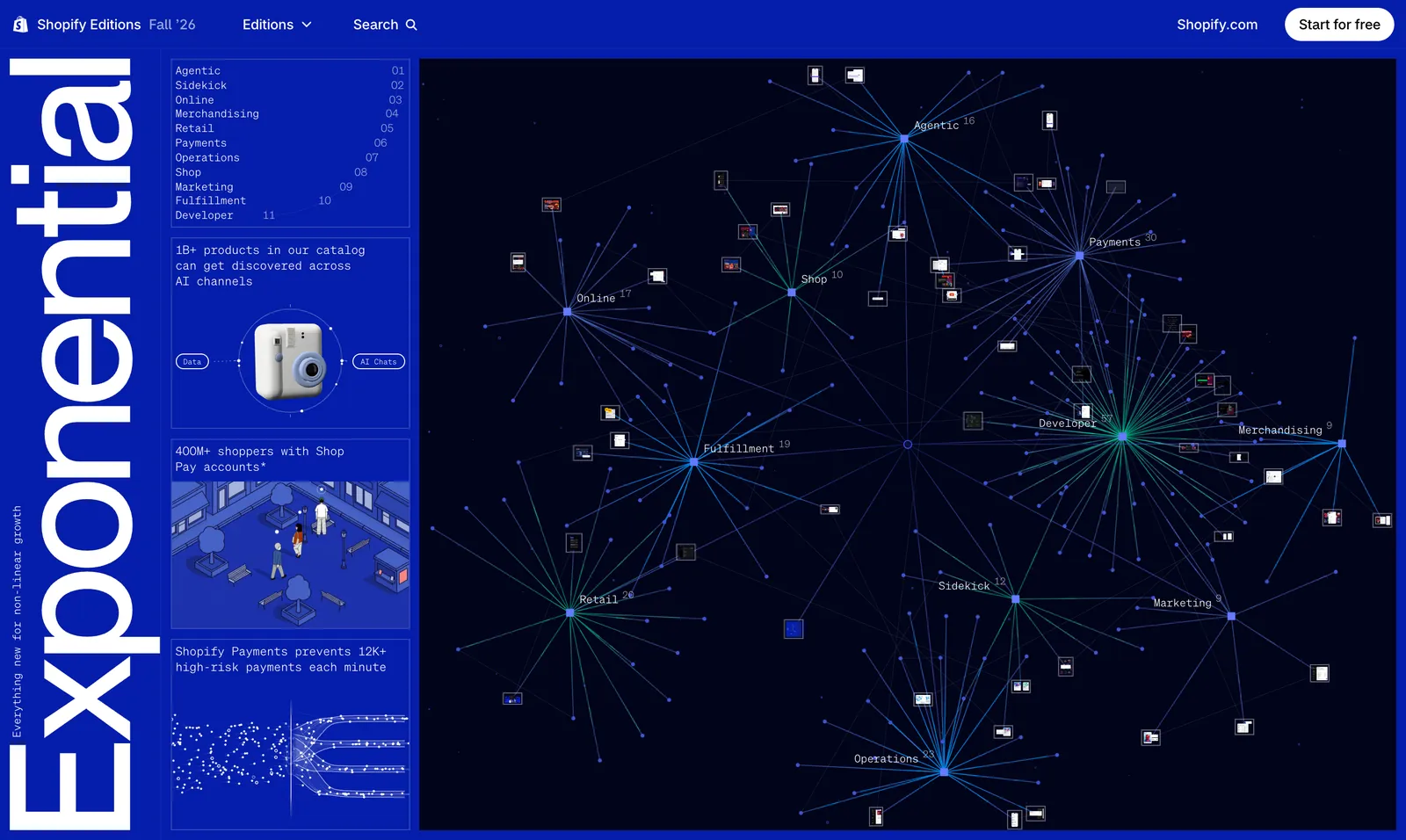
Shopify publishes a structured dataset behind its Editions page at www.shopify.com/editions/fall2026/graph-data. It contains the full release graph — 222 updates across 11 sections, each carrying an official weight from 1 to 5, plus outcome, theme, persona and product labels.
Two readings matter for marketers. First, the Developer section holds 57 of the 222 updates (25.7%) — nearly double the second-largest section. This release was aimed at how other systems plug into Shopify, not at new buttons for merchants. Second, the Agentic section contains only 16 updates but carries the highest average official weight of any section. Small in count, heaviest in stated importance — the signature of a foundation layer.
And the label you would expect to dominate does not. Discoverability is attached to roughly 7% of updates, while time-saving and conversion labels dominate. Shopify did not frame Fall '26 as a traffic event. It framed it as a transaction event — which is exactly why a traffic-first prioritisation of the work gets the order wrong.
The six layers that decide whether an agent can buy from you
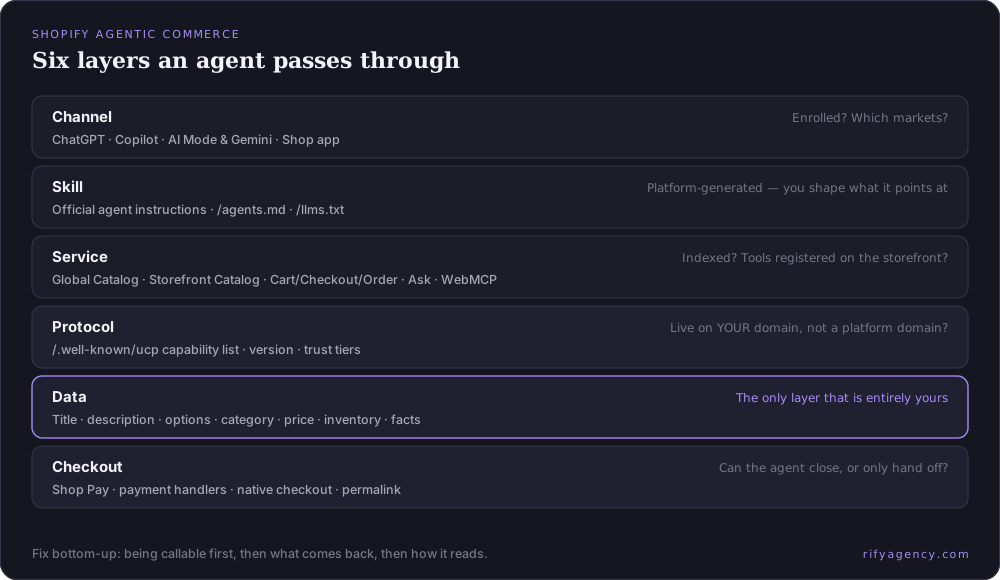
- Channel layer — which assistants your catalogue reaches (ChatGPT, Microsoft Copilot, Google AI Mode and the Gemini app, the Shop app). You control whether you are enrolled and in which markets.
- Skill layer — the official Shop skill plus your /agents.md and /llms.txt. On Shopify these two files are platform-generated; what you influence is the policies and facts they point at.
- Service layer — the Global Catalog MCP, your Storefront Catalog MCP, cart/checkout/order MCP, Ask, and the WebMCP tools registered on your storefront pages.
- Protocol layer — the /.well-known/ucp capability list, the negotiated UCP version, trust tiers and rate limits. Platform-managed; your job is verifying it is actually live on your domain.
- Data layer — titles, descriptions, media, options, standard product category, price, compare-at price, inventory and published knowledge-base facts. This is the only layer that is almost entirely yours.
- Checkout layer — Shop Pay, declared payment handlers, native-checkout eligibility and permalink destination. Decides whether the agent can close in-conversation or only hand off a link.
Fix them bottom-up, not top-down
Most teams start at the data layer, because rewriting product titles feels like marketing work. That is the wrong order. If the protocol or checkout layer is broken, improving the data layer only raises the quality of an interface nobody can call.
The correct sequence is: confirm you can be called at all, then confirm what comes back looks good, then compete on how it reads. We ran the same six checks against eight live Shopify storefronts on 2026-10-31 — a small sample that shows this class of failure happens, not how often it happens. Two of the eight returned 404 for both /agents.md and /llms.txt. Those same two also registered zero browser-side tool markers on the homepage and pointed their checkout permalink away from the brand apex — one at a myshopify domain, one at a separate shop subdomain. Nothing about their product copy mattered on that path, because the entry points were not there.
Two catalogues, two different games
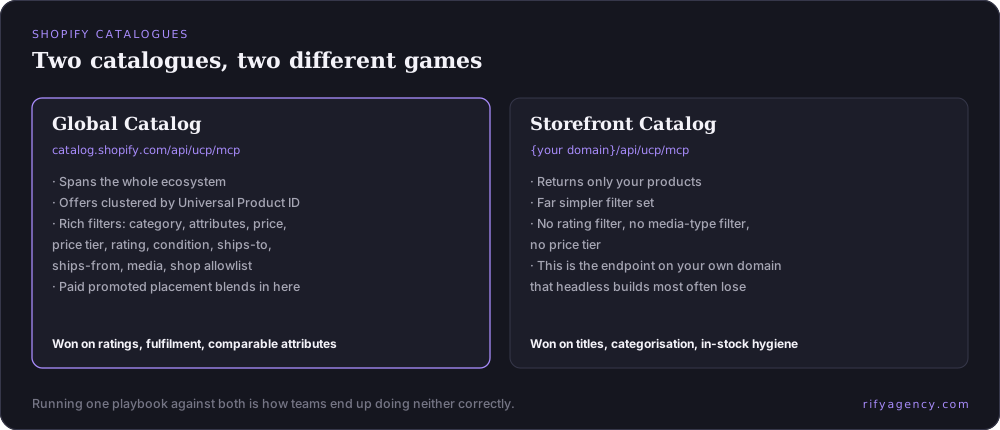
This is the structural fact most guides miss. Shopify exposes two catalogues to agents, with different endpoints, different fields and different ranking logic.
The Global Catalog (documented at shopify.dev/docs/agents/catalog/global-catalog) spans the whole ecosystem. Results are clustered by Universal Product ID, which means multiple merchants' offers for the same product compete side by side — the buy box returns, with an AI agent as referee. It supports a rich filter set including category, a constrained attribute list, price, price tier, rating, condition, ships-to, ships-from, media type and a shop allowlist.
Your Storefront Catalog (shopify.dev/docs/agents/catalog/storefront-catalog) only ever returns your own products, and its filters are far simpler. Optimising for one as though it were the other is how teams end up doing neither correctly. Cross-store competition is won on ratings, fulfilment and comparable attributes; single-store retrieval is won on titles, categorisation and in-stock hygiene.
What to do in the first 30 days
- Run the six-layer check on your live domain and record a pass/fail per layer — this is a boolean, not a trend line.
- Confirm catalogue eligibility: active policies in settings, agreed agentic storefront terms, products with a title, at least one image, a price above zero, and publication to a storefront channel.
- Normalise your standard product category and the attributes the Global Catalog filters actually accept — unsupported attribute names are simply ignored.
- Rewrite your top 50 product descriptions as extractable facts rather than brand poetry: material, dimensions, compatibility, use case, concrete differences.
- Publish your knowledge-base facts (returns, shipping, warranty, contact) so policy questions have a sourced answer.
- Move purchase measurement server-side before you evaluate performance, or your first read on the channel will be wrong.
Where RIFY Agency fits
We are a Shopify agency built around AI search. Our Agentic Commerce and AI Visibility (GEO/AEO) services run exactly this sequence — protocol and checkout verification first, then catalogue and product-data remediation, then the ongoing content and citation programme that gets a brand recommended in ChatGPT, Google AI Overviews, Perplexity and Gemini. The same methodology powers our in-house product GEOly.
If you want a read on where your store currently sits, the fastest starting point is an AI visibility and agent-readiness assessment of your live domain: what agents can see, what they cannot call, and which of the six layers is costing you the most. Tell us your domain and we will walk you through the findings.
よくある質問
Do I need to build anything to support agentic commerce on Shopify?
For the protocol itself, usually not — eligible Shopify stores expose UCP, agents.md and the storefront MCP endpoint automatically. What does need work is eligibility, product data quality, knowledge-base facts, checkout configuration and, for headless storefronts, verifying the agent surfaces exist at all.
Is agentic commerce worth attention if it is still a small share of my revenue?
The argument for acting now is cost, not volume. Most of the work is one-time configuration and data hygiene, and the failure mode is binary: an agent either returns your product or returns nothing. Compared with SEO, there is no gradual decline to monitor and no partial credit.
How is this different from GEO or AEO?
GEO and AEO are about being mentioned and cited in AI answers. Agentic commerce is about being retrievable and purchasable by a tool call. They stack: an agent usually needs to know your brand before it searches for you by name, and the product link it returns still gets opened by a human.
Which AI channels can a Shopify store actually reach today?
Eligibility differs by channel and market and changes often, so verify in your admin rather than trusting a blog post. As of this writing, ChatGPT and Microsoft Copilot have the broadest merchant eligibility, while Google AI Mode and Gemini checkout have been narrower. Check Sales channels in your Shopify admin for your current status.
関連記事
 Shopify Editions Fall '26: The Updates That Change Acquisition222 updates, 11 sections, and most coverage focused on the wrong ones. We read Shopify's own structured release data to find where the weight sits — and pulled out the nine updates that change how a brand gets found, chosen and measured.→
 Shopify GEO Strategy After Fall '26: Ranking to Being CalledEcommerce visibility now has three levels, not two: being indexed, being cited, and being callable. They stack rather than replace each other, their failure modes are completely different, and only one of them is a switch. Here is how to structure a GEO programme for a Shopify brand accordingly.→
 Your Analytics Undercounts Agentic Orders: How to Fix ItWhen a purchase completes inside an AI assistant, your thank-you page is never loaded, so every event bound to it silently stops firing. Revenue is fine. Reporting is not. Here is the system-by-system repair, and why this is the first project rather than the last.→
 Promoted Placement: Paid Rank Inside AI Shopping AnswersShopify's cross-store catalogue now blends paid placements into the ranked organic results an AI agent sees, with a commission attached and mandatory disclosure. This is the moment agentic commerce gets an advertising layer — and the line between paid and organic is blurry by design.→