
Shopify GEO Strategy After Fall '26: Ranking to Being Called
Ecommerce visibility now has three levels, not two: being indexed, being cited, and being callable. They stack rather than replace each other, their failure modes are completely different, and only one of them is a switch. Here is how to structure a GEO programme for a Shopify brand accordingly.
AI Search & GEO Shopify Platform
Three levels, three referees
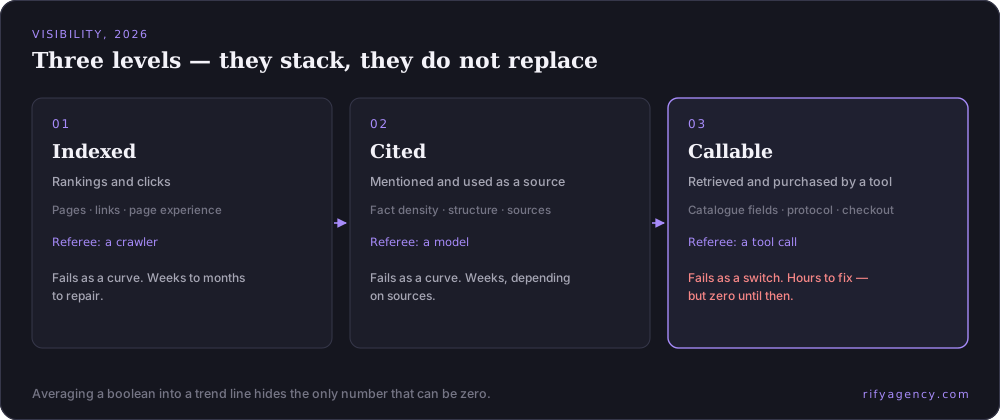
For fifteen years ecommerce visibility had one level: being indexed. The goal was rankings and clicks, the assets were pages, links and page experience, and the referee was a crawler.
Around 2023 a second level appeared: being cited. The goal became getting mentioned and used as a source in AI answers, the assets became fact density, structured expression and source distribution, and the referee became a model. This is the work most people mean by GEO or AEO.
Fall '26 put a third level in front of everyone: being callable. The goal is no longer appearing in an answer but letting an agent retrieve you, understand you, and complete the order without leaving the conversation. The assets are catalogue fields, protocol capabilities and checkout eligibility. The referee is whether a tool call succeeded or failed.
Why the failure modes matter more than the definitions
At level one, failure looks like declining rankings and eroding traffic. It is a curve, it is gradual, and it can be repaired incrementally over weeks or months.
At level two, failure looks like absence from an answer, or being described inaccurately. Also a curve, repairable over weeks, depending on your source footprint and content freshness.
At level three, failure looks like a tool returning nothing, or being able to show a product but not complete a purchase. There is no middle state. It is fixable in hours — but until it is fixed, it is zero.
This is why a single AI visibility percentage is a poor operating metric for a Shopify brand. One of your three levels is a boolean, and averaging a boolean into a trend line hides the only number that can be zero.
How the levels stack
They are additive, not substitutional, and the dependencies run in both directions. An agent generally has to know your brand from the model's world view — level two — before it will search for you by name in a tool — level three. The product link the tool returns still gets opened by a human, where page quality and speed decide the sale — level one. And your public HTML remains legitimate supplementary context: the platform-generated agent manual explicitly permits read-only browsing of your sitemap, product and collection pages.
So the honest answer to does SEO still matter for a Shopify brand is yes, and it now has two additional jobs: feeding the model layer that decides whether you are known at all, and remaining the destination that converts the traffic the other two levels generate.
A programme structure that reflects this
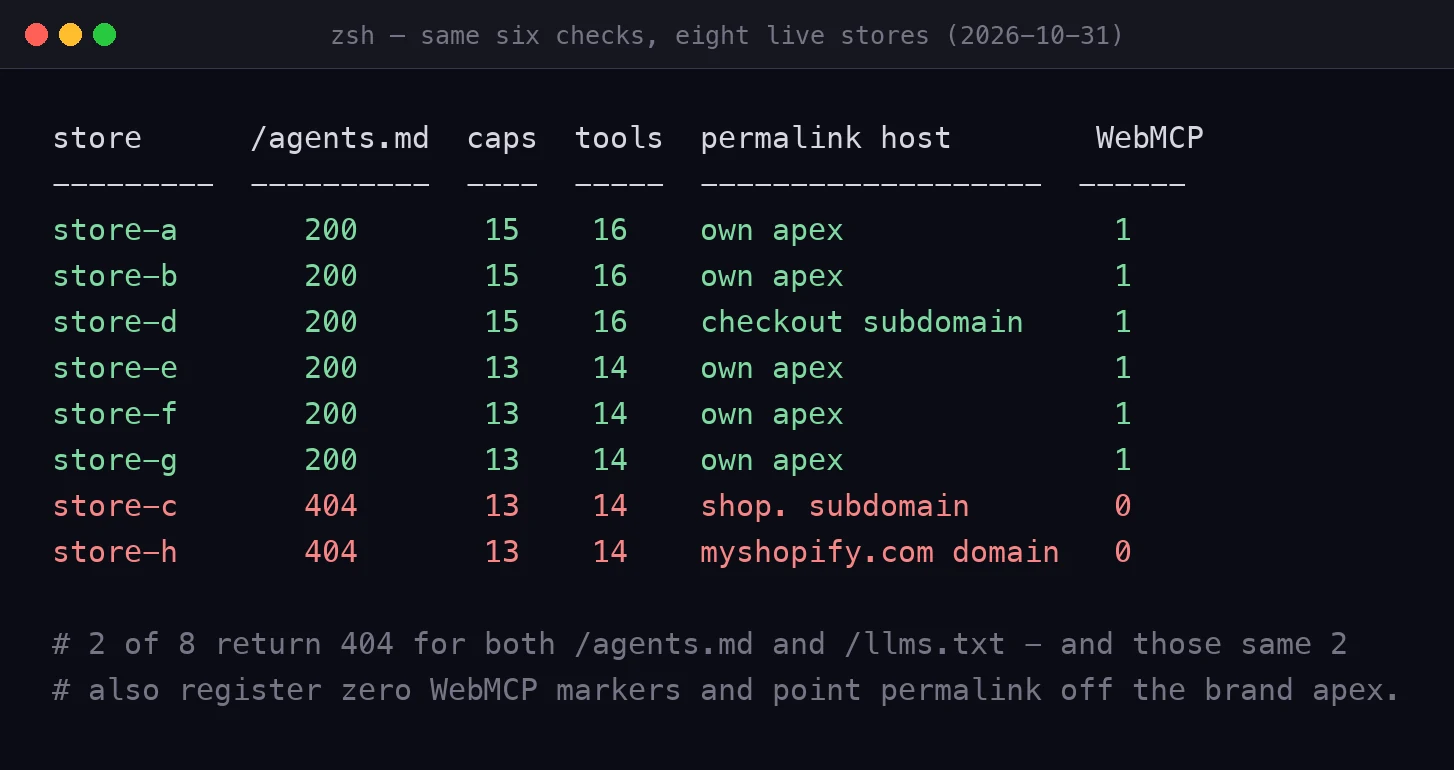
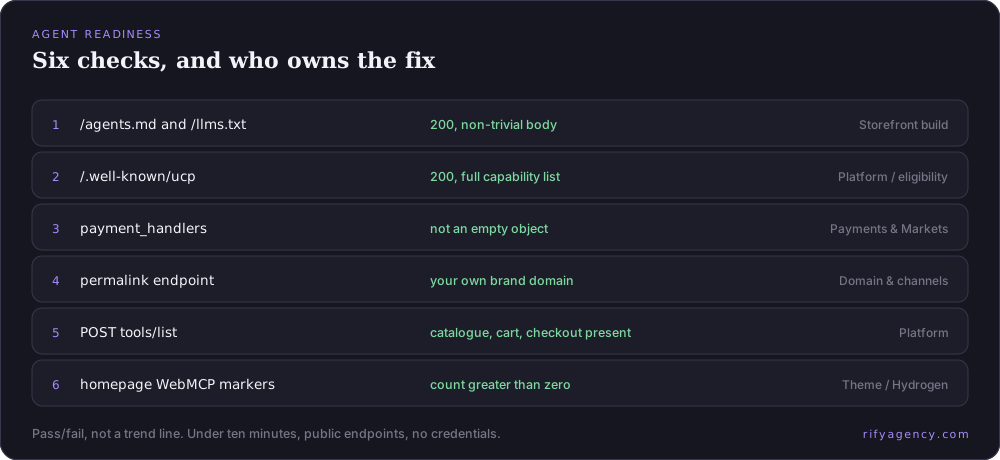
- Level three first, because it is cheapest and binary. Verify endpoints, capability list, payment handlers, permalink destination and browser-side tool registration. Confirm catalogue eligibility. Normalise standard category and the attributes cross-store filters actually accept. Clear out-of-stock products. Publish knowledge-base facts.
- Then level two, because it is slowest. Build answer-first content that states conclusions and numbers up front, keep your facts identical across your site, your knowledge base and off-site sources, and run the source and citation programme that makes a brand known in model answers.
- Keep level one running throughout, with the technical foundations that serve both human and machine readers: clean information architecture, structured data, speed, internal linking, correct canonicalisation and hreflang if you are multi-market.
- Measure them separately. A pass/fail panel for level three, citation and mention tracking for level two, and conventional search performance for level one. One blended score hides all three.
A naming warning specific to Shopify
If you are searching for help with this, be aware that on Shopify the abbreviation GEO is heavily contaminated. Search volume for Shopify-plus-GEO terms is dominated by geolocation, geo-redirect and market-routing apps rather than generative engine optimisation.
Practically, that means two things. When briefing vendors, spell out generative engine optimisation or answer engine optimisation rather than relying on the abbreviation. And when assessing your own content opportunity, expect the clearer queries to be phrased around AI search, ChatGPT, AI Mode, AI shopping or agentic commerce rather than around GEO — which is also, incidentally, a genuinely open content space right now.
Where to start this month
- Run the level-three verification on your production domain and record a pass/fail per item. It takes under ten minutes and tells you whether anything else is worth doing yet.
- Pick your ten highest-value category terms and establish what assistants currently say when asked about them. That is your level-two baseline.
- Audit fact consistency on returns, shipping and warranty across your policy pages, knowledge base, on-site content and off-site profiles. Inconsistency here is one of the most common reasons brands get described wrongly.
- Fix purchase measurement server-side before you set any targets.
- Rewrite your top sellers' product copy as extractable facts. It is the one asset that serves all three levels at once.
Working with us
This three-level structure is how we scope engagements. The agent-readiness work is bounded and fast. The AI visibility programme — the GEO/AEO content, fact consistency and source work that gets a brand mentioned and recommended across ChatGPT, Google AI Overviews, Perplexity and Gemini — is ongoing, and we monitor it with our own product GEOly. The technical SEO foundation underneath serves both.
If you want a candid read on which level is costing you the most right now, that is the conversation to have first. Send us your domain and your primary category and we will start from what we can verify publicly, before anyone talks about scope or budget.
Soalan lazim
Does GEO replace SEO for Shopify brands?
No. The three levels stack. SEO feeds the model layer that decides whether you are known, and the product page remains the destination that converts traffic from both AI answers and agent-returned links. What changes is that SEO alone is no longer sufficient.
What is the single best first metric?
A boolean: can an agent retrieve your flagship products on your core category terms, and can it complete a checkout. Percentages and trends only become meaningful once that answer is yes.
How long does this take to show results?
The agent-readiness layer is hours to weeks of work and its effect is immediate because it is a switch. The citation and mention layer behaves more like content and PR timelines — weeks to months, depending on your category and existing source footprint. Be wary of anyone promising a fixed date for the second.
We have a small team. What do we skip?
Skip nothing at level three — it is cheap and binary. Narrow level two instead: pick five category terms rather than fifty, and get fact consistency and answer-first content right on a small set before expanding.
Bacaan lanjut
 Shopify Editions Fall '26: The Updates That Change Acquisition222 updates, 11 sections, and most coverage focused on the wrong ones. We read Shopify's own structured release data to find where the weight sits — and pulled out the nine updates that change how a brand gets found, chosen and measured.→
 Promoted Placement: Paid Rank Inside AI Shopping AnswersShopify's cross-store catalogue now blends paid placements into the ranked organic results an AI agent sees, with a commission attached and mandatory disclosure. This is the moment agentic commerce gets an advertising layer — and the line between paid and organic is blurry by design.→
 How to Sell on ChatGPT with Shopify: Setup and Real LimitsGetting your Shopify products into AI assistant conversations is mostly a qualification exercise, not an integration project. Here are the eligibility gates, what the setup actually involves, and the five constraints that decide whether an agent recommends you or skips you.→
 Headless Shopify and AI Visibility: Four Migration ChecksWe ran the same six agent-readiness checks against a standard Liquid store and a headless storefront on a custom domain. The headless store failed four. None of them appear on a typical migration acceptance checklist — and all four take minutes to verify.→
Sedang membina sesuatu yang besar?
Beritahu kami tentang jenama, matlamat dan garis masa anda — kami akan hubungi anda semula dengan langkah seterusnya.