
Shopify Agentic Knowledge Base: Facts AI Agents Will Quote
For the first time, Shopify merchants have a sanctioned place to put their own wording in front of AI agents. The knowledge base is a reviewed fact library covering policies and FAQs — and one of its outlets is already live, even though the protocol capability it was built for is still a draft.
What it is
Buried in the Fall '26 release is an update described plainly as reviewing and approving the facts shared with agents, including policies and FAQs. Behind that sentence is a new admin surface and a new protocol capability.
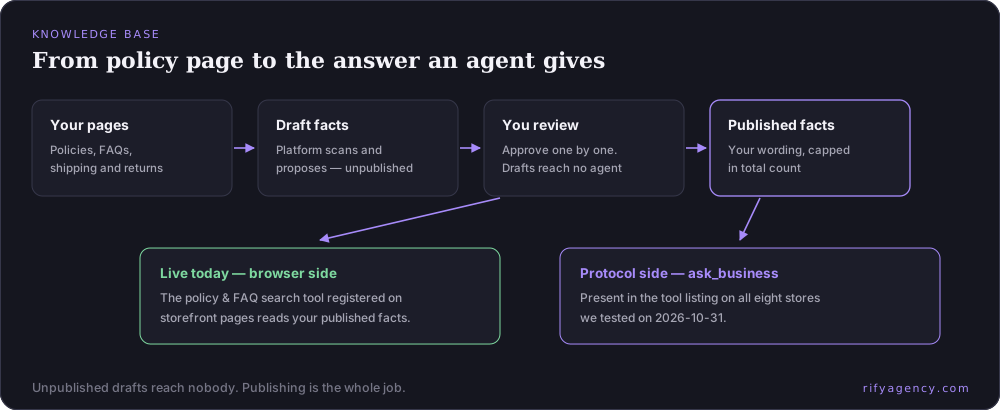
The admin surface lives under sales channels in the agentic section. Shopify scans your storefront and policy pages and generates unpublished draft facts; you review them one by one and publish the ones you approve. Shopify's documentation states it does not change knowledge base content on your behalf, and unpublished drafts do not reach any agent. There is a cap on total published facts, so this is a curation exercise rather than a dump.
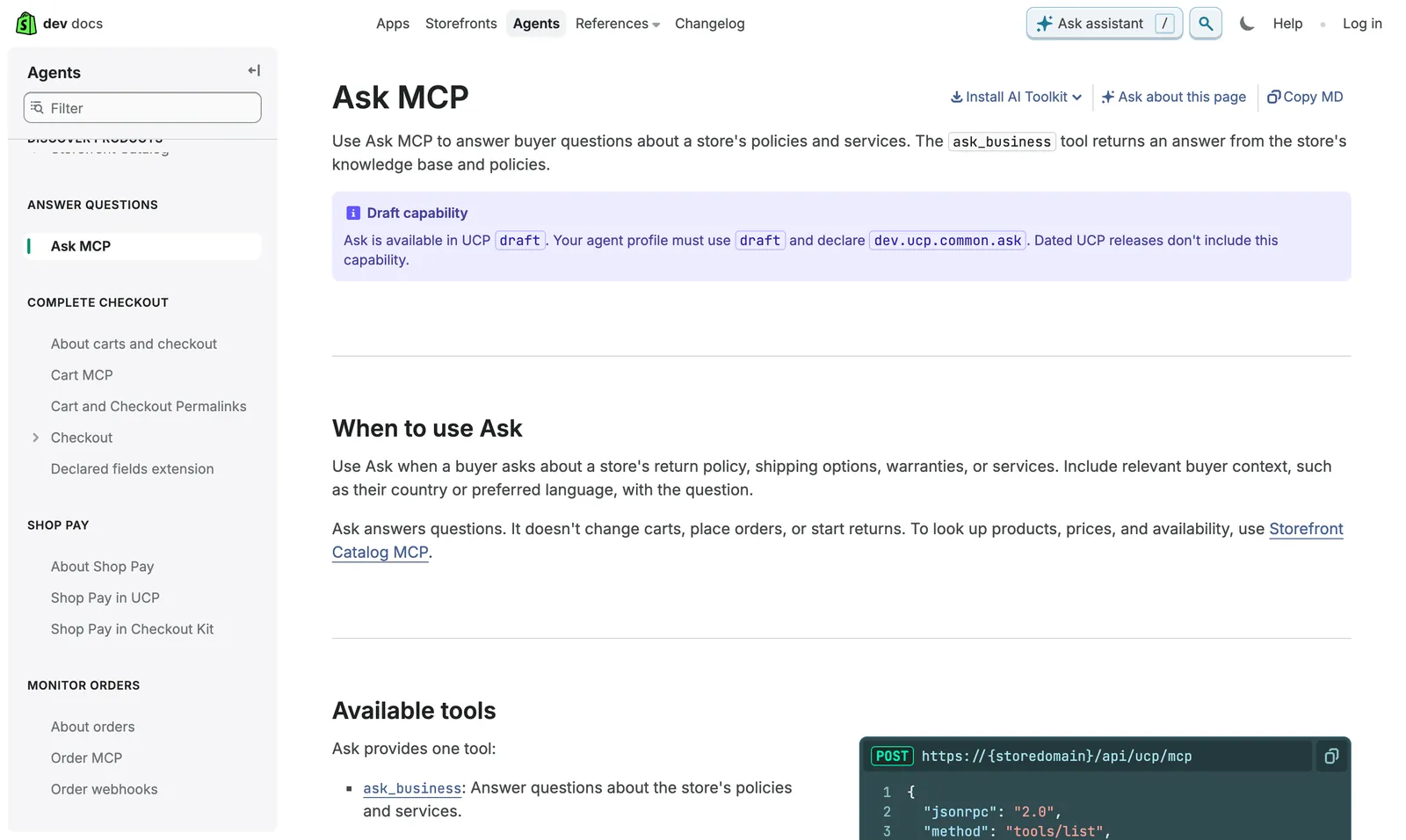
The protocol side is the Ask capability, documented at shopify.dev/docs/agents/ask. Its single tool answers policy and service questions — returns, shipping, warranty, service scope — from that fact library.
The timing detail that decides your priority
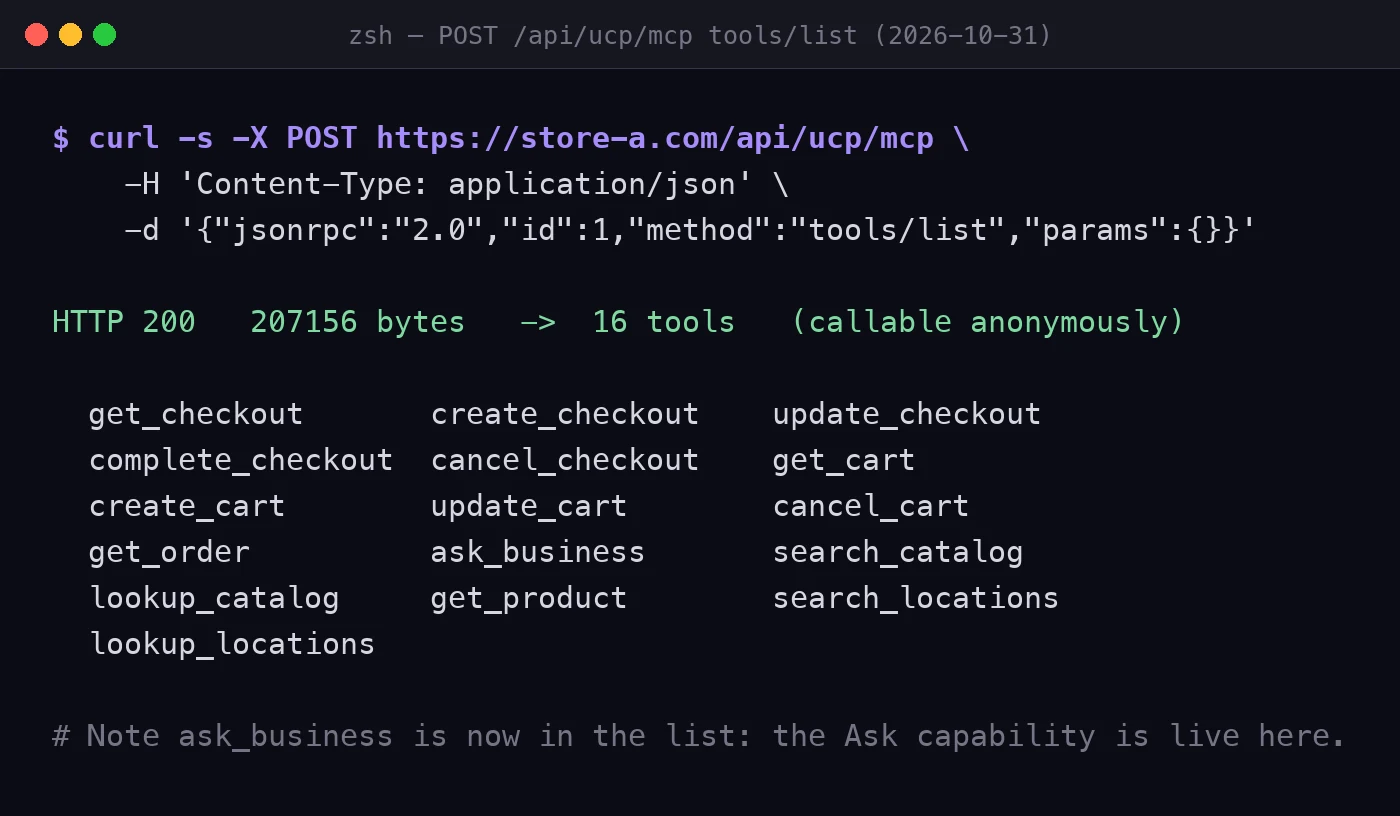
This is the part that changed recently, and it is worth being precise about. Shopify's own documentation has carried Ask as a draft capability, which meant stores negotiating a dated protocol version would not expose it — and reporting from late October reflected exactly that. When we re-ran the check on 2026-10-31 across eight live storefronts, ask_business was present in the tool listing of every single one.
So the answer to can my store answer agents' policy questions today has moved from probably not yet to probably yes — go and check your own tool listing rather than trusting either answer. And it is not the only outlet: among the structured tools Shopify registers on storefront pages is a shop policies and FAQ search tool, which also reads your published facts. A buyer browsing your store with a browser-resident agent can already get your approved wording.
Which creates an unusually clean situation: the endpoint is live and almost nobody has published anything into it. The tool exists on every store we checked; whether it returns your wording or an unhelpful blank is entirely a function of whether someone sat down and approved the facts. There is no wasted-effort case here, and right now there is very little competition for the answer.
What to publish, in priority order
- Returns and exchanges — window, condition requirements, who pays return shipping, how refunds are issued and how long they take.
- Shipping and delivery — which countries you ship to, which carriers, dispatch times, delivery estimates by region, and what happens with customs and duties.
- Warranty and after-sales — coverage period, what is covered, how to claim, whether registration is required.
- Sizing and fit, or technical compatibility — the questions your support inbox actually receives most.
- Contact and service hours — how a buyer reaches a human, in which languages, and the realistic response time.
- Product care and materials — the facts that reduce returns when stated up front.
How to write a fact an agent will use
The Ask capability returns plain text answers in a single turn, with no multi-turn conversation and no guarantee of markdown, source links or session continuity. That shapes how you should write.
Write each fact as a complete, self-contained statement that makes sense with no surrounding context. Not see our returns policy for details, but returns accepted within 30 days of delivery, unused and in original packaging, with return shipping paid by the buyer except for defective items. Include the numbers. State the exceptions in the same sentence, because there is no follow-up turn in which to add them.
And keep them true. The same official skill that governs agent behaviour instructs agents to state material unknowns and declines to confirm delivery by a deadline, pointing buyers to your checkout for delivery options instead. That gap is a position you can take with accurate shipping facts — but only if the facts hold up.
The seasonal opportunity most brands will miss
The official skill is explicit that shipping eligibility does not establish arrival by a deadline, and that when a buyer names a date the agent should say search cannot confirm arrival by then. During peak season — Black Friday through Christmas — that is the single most common buyer question, and the default agent answer is an unhelpful shrug.
Brands with accurate, published cut-off dates and regional delivery estimates give the agent something concrete to work with on the one question buyers care most about in the highest-intent weeks of the year. This is a content task, not an engineering one, and it has a deadline.
Where this fits in a GEO programme
We treat the knowledge base as the storefront end of a single fact-consistency problem. The same policies need to be correct on your policy pages, in your knowledge base, in your on-site FAQ content and in the off-site sources AI systems read about you — because inconsistency between those is one of the most common reasons an assistant describes a brand incorrectly.
That consistency work is the core of our AI Visibility (GEO/AEO) and AI content architecture services: one source of truth, expressed correctly in every surface an AI system can reach. If your returns policy currently reads differently in three places, that is where we would start — tell us your domain and we will show you the discrepancies we can see from outside.
常見問題
Where is the knowledge base in the Shopify admin?
Under sales channels, in the agentic section. It replaced a previously separate knowledge base application, and stores that were over the fact limit on the old app needed to migrate manually before the retirement date, so check your state if you used it.
Can Shopify edit or rewrite my facts?
Shopify's documentation states it does not change knowledge base content on your behalf. It generates unpublished drafts from your existing pages, which you review and approve. Note this is different from the cross-store catalogue, where some product fields are explicitly marked as inferred and may be generated or enhanced.
Is the Ask capability actually live on my store?
Check rather than assume — this moved recently. Shopify documented Ask as a draft capability, but when we ran tools/list against eight live storefronts on 2026-10-31, ask_business was present on all eight. Either way the work is the same: an exposed tool with no published facts behind it returns nothing useful.
How many facts should we publish?
There is a platform cap, so curate rather than dump. In practice, start from your support inbox: the twenty questions you answer most often, written as self-contained statements with numbers, cover most of the value.
延伸閱讀
 Shopify GEO Strategy After Fall '26: Ranking to Being CalledEcommerce visibility now has three levels, not two: being indexed, being cited, and being callable. They stack rather than replace each other, their failure modes are completely different, and only one of them is a switch. Here is how to structure a GEO programme for a Shopify brand accordingly.→
 Promoted Placement: Paid Rank Inside AI Shopping AnswersShopify's cross-store catalogue now blends paid placements into the ranked organic results an AI agent sees, with a commission attached and mandatory disclosure. This is the moment agentic commerce gets an advertising layer — and the line between paid and organic is blurry by design.→
 How to Sell on ChatGPT with Shopify: Setup and Real LimitsGetting your Shopify products into AI assistant conversations is mostly a qualification exercise, not an integration project. Here are the eligibility gates, what the setup actually involves, and the five constraints that decide whether an agent recommends you or skips you.→
 The 14 Fields AI Agents Actually See on Shopify ProductsWe counted the top-level fields in a live Shopify catalogue response: fourteen. Ratings, review text, 3D models and video were absent from that schema entirely. Here is what agents really receive — and how to rewrite product copy so the fields that do exist work for you.→