
UCP vs ACP: The Two Agentic Commerce Protocols, Compared
Two protocols are competing to standardise AI-agent shopping: the Universal Commerce Protocol and the Agentic Commerce Protocol. They solve overlapping but different problems — and for most Shopify merchants the right answer is not to pick one.
The short answer
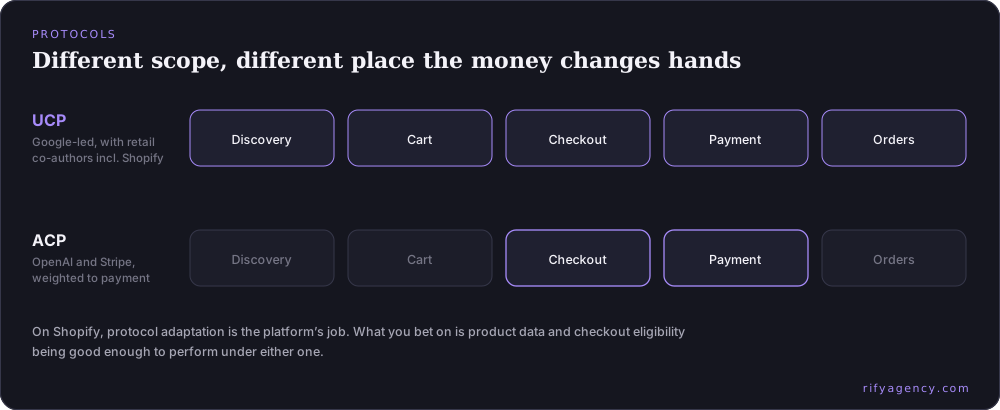
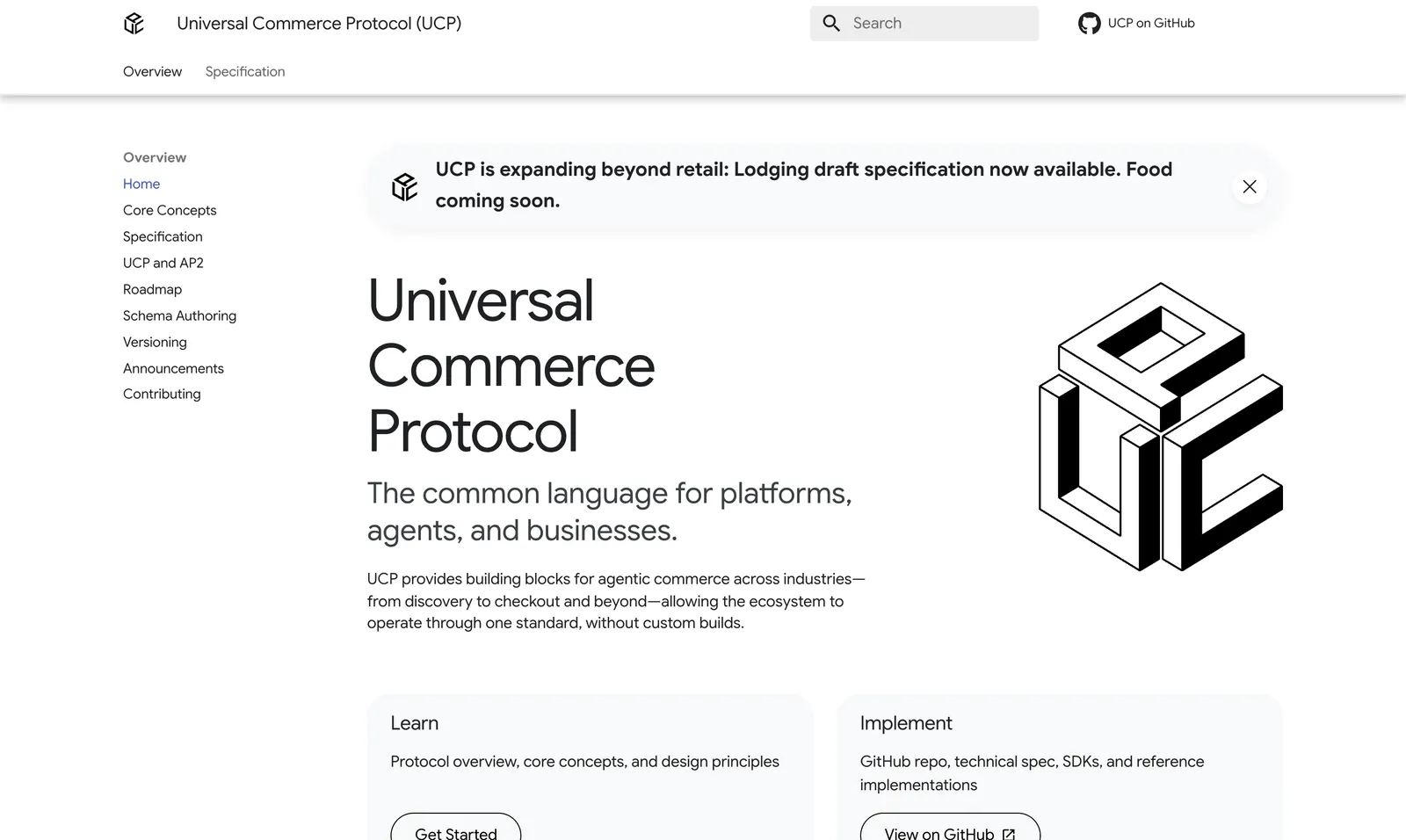
The Universal Commerce Protocol (UCP, specification at ucp.dev) covers the full shopping journey: product discovery, cart, checkout, account linking and order management, with checkout that can close inside the agent interface. It was led by Google and developed with retailers including Shopify.
The Agentic Commerce Protocol (ACP) is the OpenAI and Stripe effort, and it is weighted toward standardising checkout and delegated payment. In practice it sits closer to discovery and referral, with the transaction completing against the merchant's own checkout.
If you sell on Shopify, you do not need to bet on either. Protocol adaptation is the platform's job. What you need to bet on is that your product data and your checkout eligibility are good enough to perform under any of them.
Where they actually differ
- Scope — UCP spans discovery through post-purchase order queries; ACP concentrates on the payment and checkout handshake.
- Where money changes hands — UCP supports protocol-native checkout completed in the agent surface; ACP keeps more of the transaction on the merchant side.
- Who convened it — UCP was led by Google with retail co-authors; ACP came out of OpenAI and Stripe.
- Adjacent standards — UCP is designed to interoperate with agent-payment and agent-to-agent protocols; ACP evolves inside Stripe's agentic commerce tooling.
- What a merchant has to do — on Shopify, UCP support is served by the platform on your own domain. ACP-style integrations more often involve your payments stack.
Why Shopify is in an unusually strong position here
Shopify is a UCP co-author and implements it natively on stores, while also reaching ChatGPT and other assistants through its official Shop skill and connectors. In other words, it did not tie itself to a single protocol — it turned merchant-side supply into a standard part that can be plugged into any agent.
That is the sharpest competitive edge of the Fall '26 release, and it cuts both ways. If you are on Shopify, protocol work is largely absorbed by the platform. If you are on a bespoke stack or another SaaS, the same capability becomes a line item in your engineering budget — which is one of the more concrete reasons replatforming conversations have accelerated this quarter.
What to do instead of choosing
- Verify your discovery document and tool listing resolve on your own domain, not a platform domain.
- Make sure your declared payment handlers are non-empty and your permalink destination is your own domain.
- Normalise the product attributes that cross-store catalogues can actually filter on — unsupported attribute names are ignored.
- Publish policy and service facts so an agent can answer returns, shipping and warranty questions with your wording rather than guessing.
- Rebuild purchase measurement server-side so you can read the channel regardless of which protocol delivered the order.
The one strategic judgement worth making
Protocols will keep changing; capability lists drift and draft capabilities come and go. The durable asset is the quality of what you expose: extractable product facts, accurate attributes, published policies, working checkout. Those survive every version bump, which is why we treat them as the work and treat protocol news as context.
If you want help separating the two — what is genuinely actionable in your store this quarter versus what is still a draft worth watching — our Agentic Commerce and AI Visibility (GEO/AEO) services are built around exactly that triage. Send us your domain and we will tell you which column each item belongs in.
Häufige Fragen
Will one protocol win?
Unknown, and it matters less than it appears for merchants on a major platform. Both are being adopted by large players, and platforms are increasingly supporting more than one. The merchant-side assets — product data, policies, checkout eligibility — are the same either way.
Do I need a developer to support both?
On Shopify, usually not for the protocol layer. You may need engineering help for product data normalisation at scale, ERP or PIM feeds, and moving analytics server-side.
Where can I read the primary sources?
The UCP specification is at ucp.dev, Shopify's engineering explanation at shopify.engineering/ucp, and the full agent-facing developer documentation at shopify.dev/docs/agents. For ACP, Stripe and OpenAI publish their own documentation.
Weiterlesen
 Shopify Editions Fall '26: The Updates That Change Acquisition222 updates, 11 sections, and most coverage focused on the wrong ones. We read Shopify's own structured release data to find where the weight sits — and pulled out the nine updates that change how a brand gets found, chosen and measured.→
 Your Analytics Undercounts Agentic Orders: How to Fix ItWhen a purchase completes inside an AI assistant, your thank-you page is never loaded, so every event bound to it silently stops firing. Revenue is fine. Reporting is not. Here is the system-by-system repair, and why this is the first project rather than the last.→
 Promoted Placement: Paid Rank Inside AI Shopping AnswersShopify's cross-store catalogue now blends paid placements into the ranked organic results an AI agent sees, with a commission attached and mandatory disclosure. This is the moment agentic commerce gets an advertising layer — and the line between paid and organic is blurry by design.→
 Google AI Mode and Gemini Checkout for Shopify BrandsCheckout powered by Shopify now runs inside Google Search AI Mode and the Gemini app. Your orders, customers and fulfilment are unaffected. Your measurement is not. Here is exactly what breaks, how to repair it, and the three cases where opting out is genuinely worth evaluating.→
Sie bauen etwas Ambitioniertes?
Erzählen Sie uns von Ihrer Marke, Ihren Zielen und Ihrem Zeitplan — wir melden uns mit den nächsten Schritten.