
Promoted Placement: Paid Rank Inside AI Shopping Answers
Shopify's cross-store catalogue now blends paid placements into the ranked organic results an AI agent sees, with a commission attached and mandatory disclosure. This is the moment agentic commerce gets an advertising layer — and the line between paid and organic is blurry by design.
Agentic Commerce AI Search & GEO
What it is
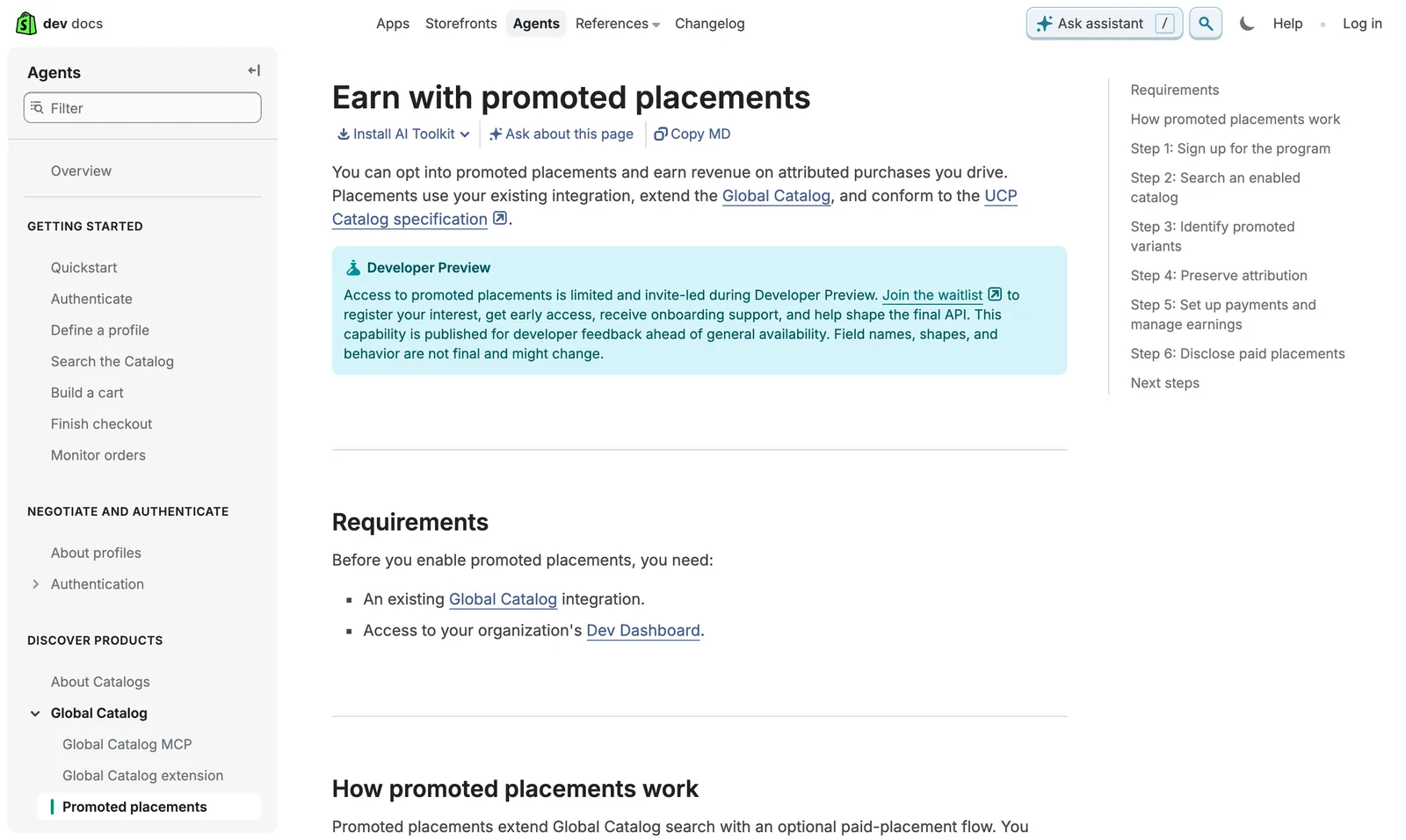
Promoted placement is a paid mechanism in Shopify's cross-store catalogue, documented at shopify.dev/docs/agents/catalog/promoted-placement. A developer enables it on a saved catalogue and passes a catalogue identifier in the search request; promoted products are then, in the documentation's own wording, blended into the ranked results.
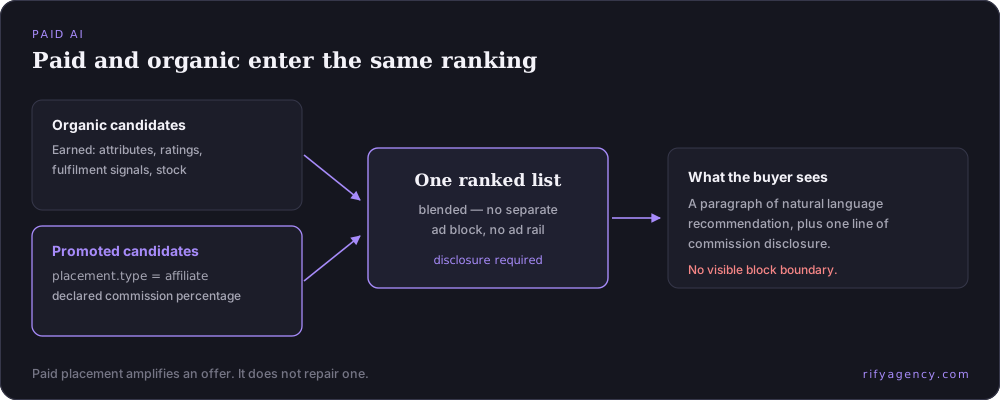
Promoted variants carry a placement object that organic results do not — identifying the placement as affiliate type and declaring a commission percentage. Shopify pays the commission, with a base rate measured against the facilitated transaction; where a merchant contributes through its campaigns product, the effective rate is the base plus the merchant contribution. Only Shopify-hosted products earn commission — externally sourced inventory never participates.
Disclosure is mandatory. Agents must tell users they may earn a commission, must make promoted results distinguishable from organic ones, and may not bury the disclosure in a footer or privacy policy.
Why this is a dividing line
In traditional search, organic results and ads are physically separate blocks on a page. The user can see which block was bought. That separation is the foundation of two decades of search marketing practice — and of user trust in organic results.
In an agent response there is no block structure. Promoted and organic candidates go into the same ranking, and the output is a paragraph of natural language with a one-line disclosure attached. The user experiences a recommendation, not a results page with an advertising rail.
Two consequences follow. For merchants, there is now a dial you can turn to influence rank directly — the first one that has ever existed in this channel. For the industry, agentic optimisation will split into organic and paid disciplines the way SEO did, except the boundary between them was blurry from day one rather than becoming blurry over fifteen years.
What else is pointing the same direction
- In-conversation advertising tooling — the release includes an app for advertising in chats with sponsored placements and performance tracking, which puts conversational ad buying and its reporting on the Shopify side.
- Fulfilment as a ranking factor — the release describes a delivery-and-returns trust badge, and states that products carrying it rank higher. That is a pure operations change that buys rank, with no media spend attached.
- Rating thresholds as filters — the cross-store catalogue filters on rating evaluated per variant against a minimum review count, which means review acquisition on lead variants functions as a ranking investment.
How to think about budget
It is early, and we would be sceptical of anyone presenting confident efficiency benchmarks for this channel today. What we would say is that the structure resembles marketplace advertising more than it resembles search advertising: you are bidding for inclusion in a clustered comparison where offers for the same product compete directly, and the commission is settled against a completed transaction rather than a click.
That shape has a clear implication. Paid placement amplifies an offer; it does not repair one. If your variant lacks reviews, your attributes are not filterable, your delivery badge is absent and your checkout cannot complete in-conversation, paying for placement puts a weaker offer in front of more buyers inside a comparison set — which is an expensive way to lose.
So the order is: qualify, fix the data, earn the operational signals, then consider buying amplification. That order is not conservatism, it is arithmetic.
The question to ask your agency
If an agency is selling you AI search services, a fair and clarifying question is: are you optimising my organic retrieval, buying placement on my behalf, or both — and how will I tell the difference in the reporting?
Because the disclosure requirement lands on the agent, not on the merchant's reporting, it will be entirely possible to show improved presence in AI answers without distinguishing which part was earned. Insist that the two are reported separately from the start. It is much harder to retrofit that distinction once a baseline has been set.
How we handle it
We separate the two explicitly. Our AI visibility and agentic commerce work is organic: eligibility, catalogue data quality, attribute normalisation, review concentration on lead variants, fulfilment signals, published policy facts, and the off-site GEO/AEO programme that makes a brand known enough to be searched by name. If paid placement is worth testing for a client, we scope it as a separate line with its own measurement.
If you are evaluating where to spend in this channel — and particularly if someone has quoted you a number for guaranteed AI visibility — we are happy to give you a straight read on what is earnable, what is purchasable, and what nobody can promise. Send us your domain and category.
Häufige Fragen
Can I buy my way to the top of an AI shopping answer?
You can influence rank through promoted placement, which blends paid candidates into the ranked results with a declared commission and mandatory disclosure. It is influence within a ranking, not a guaranteed position, and it only applies to the cross-store catalogue path.
Will buyers know a recommendation was paid for?
They are supposed to. The documentation requires agents to disclose potential commission, keep promoted results distinguishable from organic, and not hide disclosure in a footer or privacy policy. Enforcement sits with the agent implementation rather than with you.
Does this make organic agentic optimisation pointless?
The opposite. Paid placement amplifies an offer rather than repairing it, and most of the ranking inputs — filterable attributes, per-variant ratings, fulfilment signals, in-conversation checkout eligibility — are earned, not bought. A weak offer promoted into a comparison set loses faster.
How does the commission work?
Shopify pays a base commission measured against the facilitated transaction, and a merchant can add its own contribution on top through its campaigns product, making the effective rate base plus contribution. Only Shopify-hosted products earn commission; externally sourced inventory does not participate.
Weiterlesen
 Shopify Editions Fall '26: The Updates That Change Acquisition222 updates, 11 sections, and most coverage focused on the wrong ones. We read Shopify's own structured release data to find where the weight sits — and pulled out the nine updates that change how a brand gets found, chosen and measured.→
 Shopify GEO Strategy After Fall '26: Ranking to Being CalledEcommerce visibility now has three levels, not two: being indexed, being cited, and being callable. They stack rather than replace each other, their failure modes are completely different, and only one of them is a switch. Here is how to structure a GEO programme for a Shopify brand accordingly.→
 Your Analytics Undercounts Agentic Orders: How to Fix ItWhen a purchase completes inside an AI assistant, your thank-you page is never loaded, so every event bound to it silently stops firing. Revenue is fine. Reporting is not. Here is the system-by-system repair, and why this is the first project rather than the last.→
 Google AI Mode and Gemini Checkout for Shopify BrandsCheckout powered by Shopify now runs inside Google Search AI Mode and the Gemini app. Your orders, customers and fulfilment are unaffected. Your measurement is not. Here is exactly what breaks, how to repair it, and the three cases where opting out is genuinely worth evaluating.→
Sie bauen etwas Ambitioniertes?
Erzählen Sie uns von Ihrer Marke, Ihren Zielen und Ihrem Zeitplan — wir melden uns mit den nächsten Schritten.