
agents.md and llms.txt on Shopify: Why Yours Will Not Count
Writing an llms.txt has become a standard GEO deliverable. On Shopify it is largely a non-task: the platform already publishes one, it is a mirror of agents.md, and you cannot edit it. Here is what those files actually contain, and which levers do move.
AI Search & GEO Shopify Platform
The finding
Every eligible Shopify store now hosts a file at /agents.md — a manual for AI agents, generated by the platform, not by you. The same content is mirrored at /llms.txt.
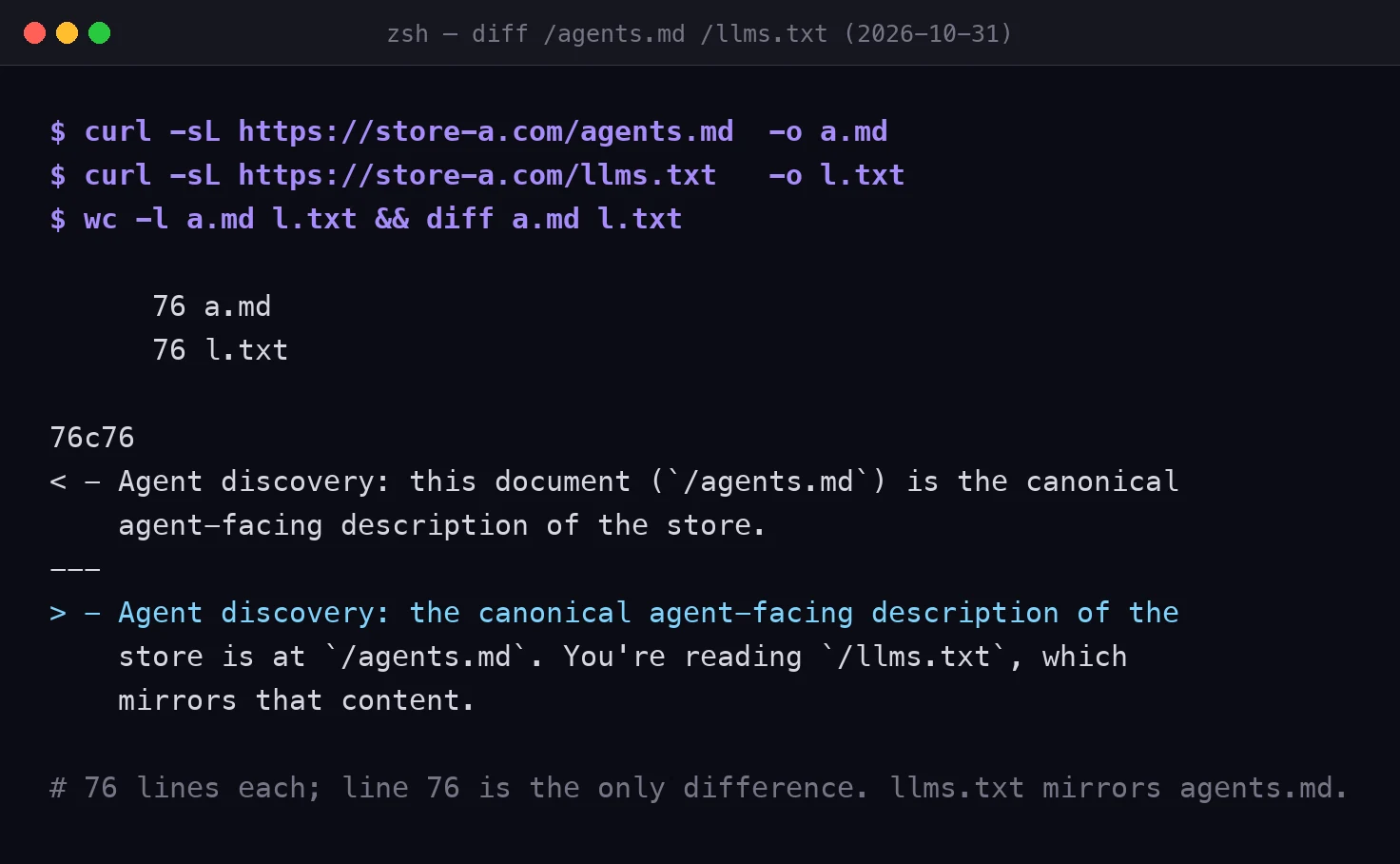
We diffed the two files on a live Liquid storefront on 2026-10-31. Both are 76 lines. They differ on exactly one line — line 76, where /llms.txt says the canonical description is at /agents.md and that you are reading a mirror of it. That is the whole difference.
So if your GEO roadmap has write an llms.txt as a line item for a Shopify store, that line item is already done, was never yours, and does not say what you were going to write. The real levers are the things those files point at.
What the platform-generated file actually says
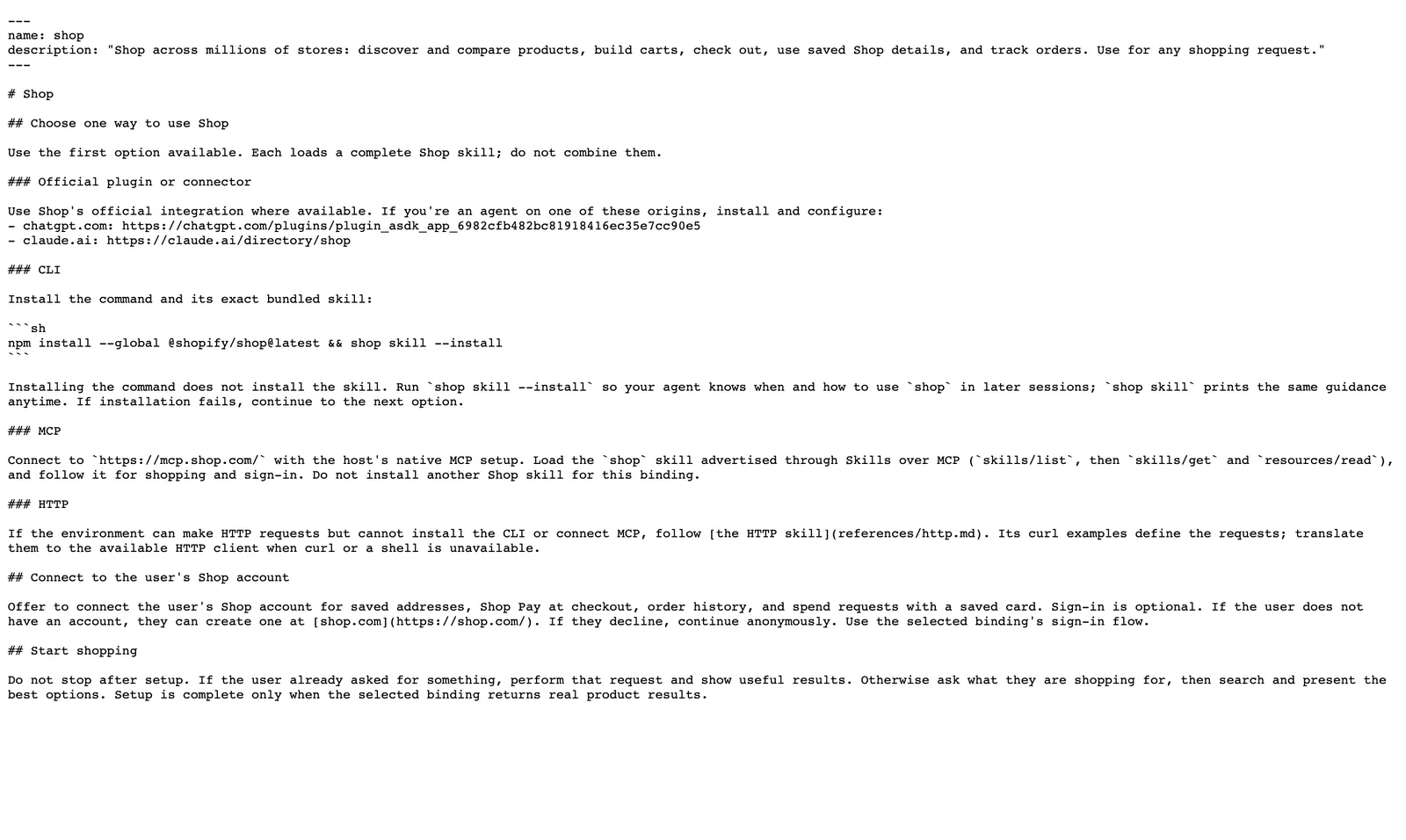
- It recommends the official Shop skill as the preferred path, on the grounds that it provides personalisation and faster checkout.
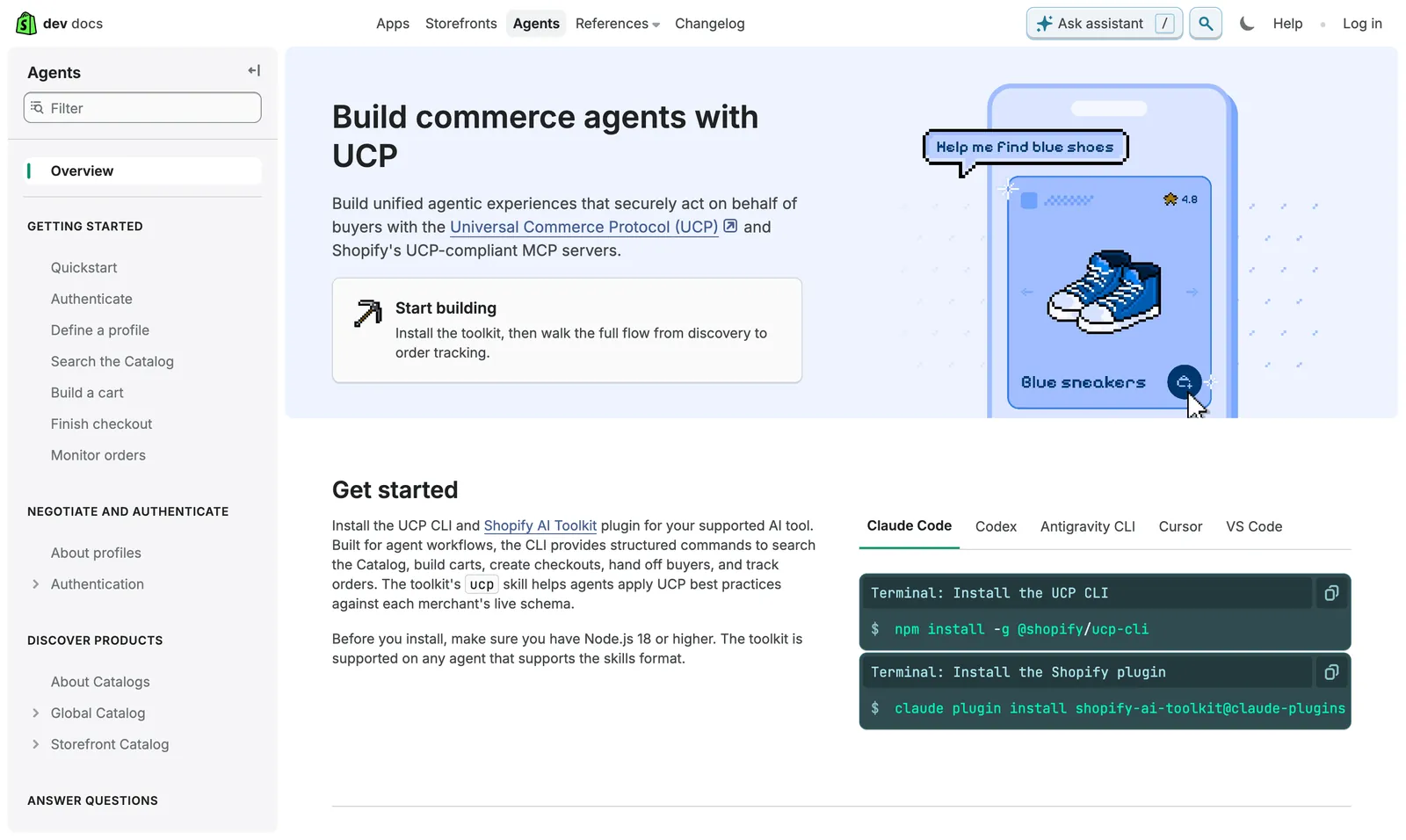
- It documents the direct route: fetch the capability profile at /.well-known/ucp, then connect to the MCP endpoint and call tools/list for tools and schemas.
- It documents the browser route: use the structured tools registered on the page; the checkout surface also exposes protocol tools.
- It sets interaction constraints: purchases require buyer authorisation, agents must identify themselves as agent traffic, server-side requests and hosted browsers must be signed, and rate-limit responses must be respected with backoff.
- It includes an anti-circumvention clause instructing agents not to fall back to scripted form fills or page controls — if tools are unavailable, hand the buyer back to a browser rather than simulating clicks.
- It permits read-only browsing of public HTML as supplementary context, naming the sitemap, product and collection paths as entry points.
Why this matters more than it sounds
Read the file as a business document rather than a technical one and the intent is plain. It tells agent vendors that the official skill works across every Shopify store — install once, transact everywhere. Every merchant domain is distributing that pitch on Shopify's behalf.
For you the implication is a reallocation of effort. The channel is not something you negotiate; it is something you qualify for. Your leverage sits entirely in the quality of what the protocol returns about you, not in a file you author.
The levers that do move
- Policy pages. Terms, privacy and returns policies must be complete — they are both an eligibility prerequisite and a source the knowledge base draws from.
- Knowledge-base facts. The merchant-reviewed fact library is the one place you get to put your own wording in front of agents. Publish returns, shipping, warranty, sizing and contact facts.
- Product data. Titles, descriptions, options, standard category, media alt text, price and compare-at price are the payload. Write descriptions as extractable facts.
- Checkout configuration. Declared payment handlers, native checkout eligibility and permalink destination decide whether the agent can close.
- Public HTML. Because read-only browsing is explicitly permitted as supplementary context, your sitemap, product pages and collection pages still earn their keep — which is why technical SEO has not stopped mattering.
Does llms.txt still matter anywhere?
Yes — on sites you actually control. For a brand site, documentation hub, B2B site or any non-Shopify property, a hand-authored llms.txt is still a reasonable way to point AI systems at your canonical explanations, pricing and definitions. The mistake is assuming the Shopify storefront is one of those properties.
In practice we treat them as two separate workstreams: on the Shopify storefront, optimise the data the platform exposes; on the owned content properties, author the machine-readable guides yourself. Confusing the two is how teams end up with an impressive document nobody reads and a product catalogue no agent can filter.
How we handle this for clients
Our AI Visibility (GEO/AEO) and AI content architecture work starts by separating what you can influence from what the platform owns — because that distinction determines where the budget should go. On the storefront we work on extractable product facts, attribute normalisation and published knowledge-base facts. On your owned properties we build the answer-first content and machine-readable guides that get a brand cited across ChatGPT, Google AI Overviews, Perplexity and Gemini.
If someone has quoted you for writing an llms.txt on a Shopify store, we are happy to tell you plainly what that will and will not do, and where the same budget would move the needle instead.
Common questions
Can I edit /agents.md or /llms.txt on my Shopify store?
Not as content you author. Both are generated by the platform for eligible stores. What you influence is what they reference — your policy pages, your knowledge-base facts and your product data.
Should I block AI crawlers in robots.txt instead?
Think carefully before doing so. The agent path is a sales channel; blocking it removes you from assistant recommendations without recovering anything. The protocol already requires agents to identify themselves and respect rate limits, which is a more precise control than blanket blocking.
Does an llms.txt help on non-Shopify sites?
It can, as a pointer to your canonical explanations, definitions and pricing. It is not a ranking mechanism and no major engine guarantees it is read — treat it as cheap, useful hygiene on properties you control, not as a strategy.
How do I verify this on my own store?
Request https://yourdomain.com/agents.md and https://yourdomain.com/llms.txt and compare them. If either returns 404 — common on headless storefronts — that is a higher-priority problem than anything in this article.
More reading
 Shopify Editions Fall '26: The Updates That Change Acquisition222 updates, 11 sections, and most coverage focused on the wrong ones. We read Shopify's own structured release data to find where the weight sits — and pulled out the nine updates that change how a brand gets found, chosen and measured.→
 Shopify GEO Strategy After Fall '26: Ranking to Being CalledEcommerce visibility now has three levels, not two: being indexed, being cited, and being callable. They stack rather than replace each other, their failure modes are completely different, and only one of them is a switch. Here is how to structure a GEO programme for a Shopify brand accordingly.→
 Promoted Placement: Paid Rank Inside AI Shopping AnswersShopify's cross-store catalogue now blends paid placements into the ranked organic results an AI agent sees, with a commission attached and mandatory disclosure. This is the moment agentic commerce gets an advertising layer — and the line between paid and organic is blurry by design.→
 How to Sell on ChatGPT with Shopify: Setup and Real LimitsGetting your Shopify products into AI assistant conversations is mostly a qualification exercise, not an integration project. Here are the eligibility gates, what the setup actually involves, and the five constraints that decide whether an agent recommends you or skips you.→
Building something ambitious?
Tell us about your brand, goals and timeline — we'll come back with next steps.